
Guess the Price guide: master all 5 modes and sharpen Black Friday deal instincts
Good price guessing is less about memorizing catalog tags and more about controlling percentage error. This guide breaks down all five modes in Guess the Price on FoolFish Games, compares a worked $200 bid across Exact Price and Don’t Go Over, and shows how practicing baseline price estimates keeps you grounded during Black Friday promotions.
Understand what each of the five modes rewards
Open Guess the Price and choose one of five 5-round modes. Exact Price and The Showcase ask for an open-ended dollar estimate, Higher or Lower tests an item against a displayed anchor price, Price Showdown pits two items head to head for 100 or 0 points, and Don’t Go Over adds a strict ceiling rule to open bidding.
Every item in the 18-product pool uses a fixed in-game reference price from $28 (pantry staples) up to $699 (camera gear). Because each game lasts five rounds worth up to 100 points each, reaching 450 out of 500 earns the Price Legend rank — an average of 90 points per round.
- Exact Price: symmetric closeness score on one item.
- Higher or Lower: 100 points for calling whether the true game price is above or below the shown mark.
- Price Showdown: 100 points for picking the higher-priced item out of two.
- Don’t Go Over: closeness score below or at the price, but 0 points if your bid exceeds the tag.
- The Showcase: one combined dollar estimate for a three-item bundle.
Worked $200 example: Exact Price vs. Don’t Go Over
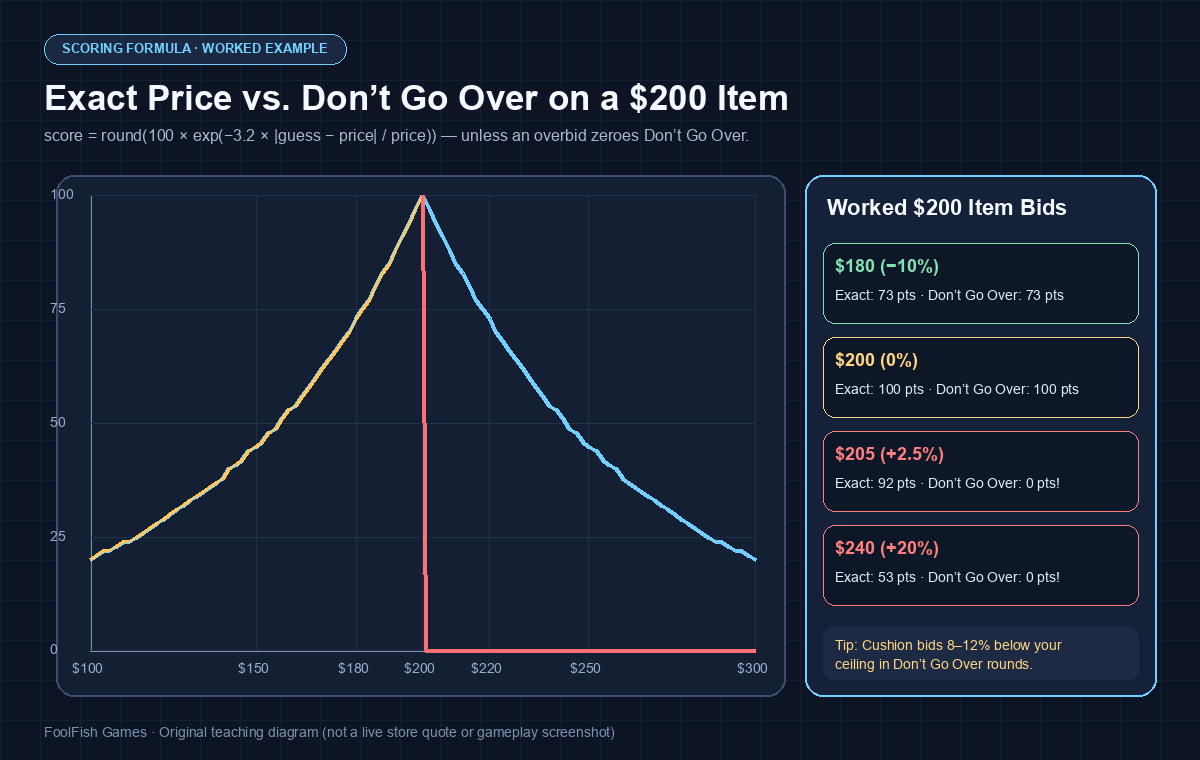
Open-bid modes measure relative error — |guess − price| ÷ price — and convert it with round(100 × exp(−3.2 × relativeError)). That means an estimate within 3% earns roughly 91 points, within 10% earns 73 points, and within 20% earns 53 points.
On a $200 item, bidding $180 (−10%) earns 73 points in both Exact Price and Don’t Go Over. Bidding $205 (+2.5%) earns a strong 92 points in Exact Price, yet drops immediately to 0 points in Don’t Go Over. When playing Don’t Go Over, shave 8% to 12% off your instinctive midpoint so a small overestimate never wipes out a five-round run.
| Your Bid | Relative Error | Exact Price Score | Don’t Go Over Score |
|---|---|---|---|
| $160 (−$40) | 20.0% | 53 pts | 53 pts |
| $180 (−$20) | 10.0% | 73 pts | 73 pts |
| $194 (−$6) | 3.0% | 91 pts | 91 pts |
| $200 (Exact) | 0.0% | 100 pts | 100 pts |
| $205 (+$5) | 2.5% over | 92 pts | 0 pts (overbid) |
Estimate three-item bundles in The Showcase without compounding error
The Showcase presents three items at once and scores your combined total using the same relative-error curve. One high-ticket tech or home item often accounts for 60% to 75% of the bundle’s dollar sum.
Price the largest item carefully first, then assign sensible mid-bracket estimates to the smaller accessories rather than agonizing over whether a mug or tea tin differs by $6. Getting the $400–$700 anchor item right keeps total bundle percentage error tiny.
- Identify the highest-bracket item (Tech, Audio or Furniture) and anchor its realistic range first.
- Add mid-range estimates for Pantry, Food or Accessory items instead of extreme highs or lows.
- Sum the three numbers cleanly before submitting — mental addition slips cost more points than small item errors.
Turn game instincts into smarter Black Friday deal checks
Retail promotions work hardest when shoppers judge the size of a markdown badge instead of the item’s standalone value. Practicing price guessing builds the opposite habit: look at the product, name what you think it is worth first, and only then compare the sale tag.
Want to test coupon arithmetic next? Try Black Friday Trivia in Discount Math mode to practice stacked percentage discounts and buy-two-get-one unit prices, or share a round with family on our Thanksgiving games online page.
Common questions
How close do I need to guess to average 90+ points per round?
Under the exp(−3.2 × relativeError) formula, keeping your guess within about 3.3% of the item’s game price scores 90 points or higher.
Does Guess the Price use live Black Friday store prices?
No. It uses fixed in-game prices across its 18-item catalog so players can compare scores fairly at any time of year.