
Wardogs and the appeal of fighting over a place
Holding the middle is easy to understand. Deciding when to leave it is the game. A tactical briefing for Reef Command, our proposed browser strategy game.
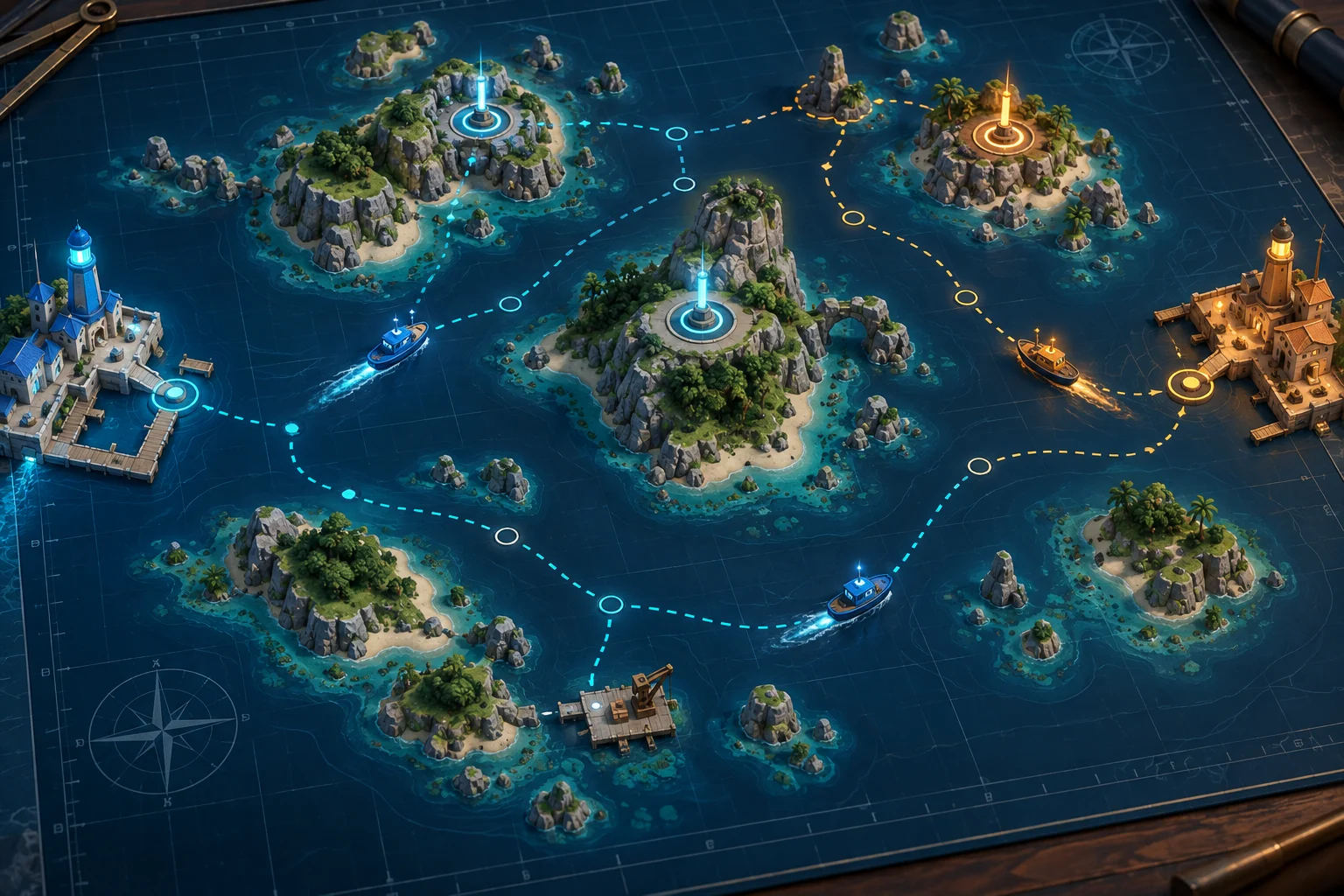
- 01CaptureReach an unopposed beacon and complete its capture timer.
- 02HoldKeep two beacons supplied to earn control points.
- 03RotateRefuel before the route home becomes too expensive.
Mission brief: the centre is not the whole map
Blue holds the western beacon. Amber is moving toward the centre. Your second patrol boat can arrive first, but it will have little fuel left. There is a supply dock on the southern route. Do you take the direct line, refuel, or threaten the eastern beacon and force the opponent to respond?
This is a proposed Reef Command encounter. It is not a Wardogs walkthrough. WARDOGS, the game introduced by Team17 and its developers, is a separate combined-arms first-person shooter. Its official pages are linked below for readers searching for that game. Our interest here is narrower: why an objective on a map can create more interesting choices than simply chasing an opponent.
Reef Command would translate that question into an original, small browser strategy game. You command patrol boats from above. You do not aim through a gun sight, and the first design does not depend on a multiplayer lobby.
Two boats, three beacons, one readable objective
The opening mission gives each side two boats and places three beacons between their home harbors. An unopposed boat captures a beacon by staying within its ring for four seconds. If both sides occupy the ring, capture pauses. A contested beacon produces no points, and a boat cannot capture it by merely passing through.
Holding at least two uncontested beacons earns one control point each second. First to 120 wins. At a six-minute limit, the higher score wins; equal scores produce a draw. Every one of these values is a prototype setting, displayed in the mission briefing so the player knows what success requires.
Boats have a movement budget, shown as fuel, and a visible durability bar. A brief, automatic exchange occurs between opponents in range; choosing a route and the moment to retreat are the player’s jobs. A disabled boat returns after a clearly displayed delay at its home harbor. There are no paid reinforcements in this proposal.
The decision that should happen before the fight
Sending both boats to the middle gives immediate pressure but leaves the western beacon undefended. Splitting them protects territory but risks losing a local two-against-one encounter. Taking the supply route costs time now and gives room to act later. A good mission makes those costs visible before an order is confirmed.
Selecting a boat would show its reachable routes, travel time and remaining fuel. Selecting a destination previews the order; a second tap commits it. A clear cancel button prevents a mis-tap from becoming an accidental charge. Opponent intentions would be hinted through visible movement, never through an unexplained instant arrival.
For the first opponent, we would prefer a readable rule set over a clever but opaque one: secure a nearby beacon, challenge the weakest defended objective, then withdraw when fuel or durability drops too far. Difficulty can change planning frequency without granting hidden speed or extra range.
Short missions belong on small screens too
A control-point strategy game for a browser needs a map that can be read at phone size. Three beacons and two player units are a deliberate limit. The portrait design would keep the score at the top, the whole mission in the middle and selected-unit commands below. No tiny right-click menus are required.
Desktop would support click-to-select and click-to-order, with keyboard focus for the same controls. Single-player missions pause when the menu opens or the app goes into the background. That pause rule would need a separate design if multiplayer were added; an opponent should never be frozen by another player opening settings.
Debrief: explain the loss, then offer another route
The result should say more than Victory or Defeat. We would show time holding two beacons, boats disabled and time spent travelling without useful fuel. A simple timeline could reveal the turning point: the centre changed hands while the western boat was returning home.
The first milestone is one complete mission, one opponent and a reliable restart. More maps, daily challenges and account-backed rankings are later possibilities. Reef Command remains a design concept; the request button records interest in compact browser tactics, not an order for an announced release.
Common questions
Can I play Wardogs on this page?
No. WARDOGS is a separate game. This article introduces an original FoolFish browser strategy concept and links to the official WARDOGS site below.
Is Reef Command multiplayer?
The first proposed version is single-player against a local opponent. Real-time multiplayer is not part of this initial plan.
Would the game need fast aiming?
The design focuses on routes, capture timing and retreat decisions. Boat combat would resolve automatically within readable ranges.
Want us to build this sooner?
Your request helps us decide which concept to prioritise. No payment, email sign-up or promised launch date.
One request per browser and concept. Stored for up to 90 days. PrivacyConcept illustrations created with AI assistance and reviewed by FoolFish Games.