
Animal RNGdle: a beginner’s guide to collecting badges
Animal RNGdle gives a daily number a woodland field-guide feel: pixel animals mark the patterns you uncover. This beginner’s guide starts before your first click, then uses a 16-badge result to explain what you earned, what counts toward your score and what an account will keep.
Before your first Animal RNGdle roll
Open Animal RNGdle in your browser and decide whether you want a quick guest session or an ongoing account history. Guest play needs no sign-in. If collecting a record of daily discoveries matters to you, sign in first: a number generated as a guest cannot be attached to an account afterwards.
The animals are badge artwork, not creatures you must identify, feed or train. The game checks 233 mathematical conditions against a random integer from 0 to 1,000,000. You do not need to solve the number yourself; the cards explain the patterns after the reveal.
- Choose guest play or sign in before pressing Generate.
- Press Generate once and let the digits and badges finish revealing.
- Read Badge Breakdown, starting with the highlighted digits on a card.
- Share the result if you like, then use the countdown to see when tomorrow’s roll opens.
What do the animal badges represent?
An animal icon helps you recognize a badge card. The name and condition tell you what you actually discovered. The artwork does not give a fox, owl or bear a special probability boost; number patterns determine the result.
Think of the badge list as a record of observations. Repeated digits can earn one card, a mirrored substring another, and a divisibility rule a third. You can discover several properties in a single roll. Earning 16 badges does not mean you unlocked 16 species or completed 16 separate levels.
One woodland roll, 16 different observations
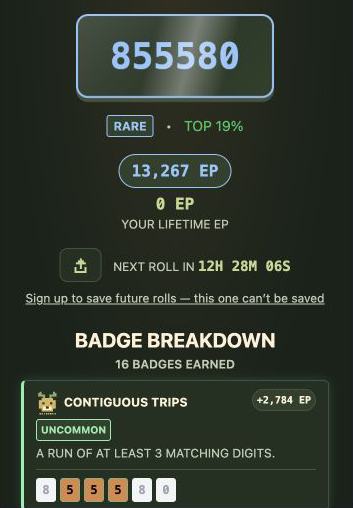
In our live Animal RNGdle session, 855580 earned 16 badges and 13,267 EP. The game labeled it Rare and Top 19%. Four of its patterns are easy to see without doing a long calculation:
The whole number is not a palindrome: it ends in 0. Pocket Mirror still applies because a smaller part, 85558, reads the same in both directions. This is a useful way to inspect an unfamiliar card—check whether its rule describes the whole number or only some of its digits.
- Contiguous Trips: the three 5s sit next to one another.
- Full House: one digit, 5, occurs at least three times, while another, 8, appears twice.
- Pocket Mirror: the first five digits, 85558, form a mirrored substring.
- Trinity: only three distinct digit values appear—8, 5 and 0.
Why earned badges do not always add extra points
A badge can be earned without adding another line of points to your total. Related rules sit in families, and only the highest-scoring earned badge from a family contributes EP. The lower badges remain visible so you can still see everything the number matched.
Our 855580 result has Two Pair, Contiguous Pair and Pair. Two Pair supplies 377 EP for that family; the other two remain discoveries but do not add 249 and 120 EP on top. Contiguous Trips belongs to a different family, so its 2,784 EP can count as well.
This separates collecting from scoring. Finding a badge you have never seen is interesting even when a stronger relative already covers its points. For an account, the Badges leaderboard offers another view alongside EP rankings. You do not need to finish all 233 badges to enjoy a daily session.
Keeping your Animal RNGdle history
Signed-in rolls are saved to your account and can contribute to your history, badge record and leaderboard. Guest results are stored locally in the same browser. Closing and reopening the page should restore that day’s result; another browser does not automatically have the same local record.
If you plan to return on a phone and a computer, use the same account and sign in before generating. Avoid clearing site data if you rely on guest storage. A guest result that is already on screen cannot be claimed later by signing in—start saving with a future account roll.
Animal RNGdle keeps its history separate from Fish RNGdle. Playing the fish version does not spend your animal attempt, transfer a badge collection or merge the two EP totals.
Compare discoveries, then return tomorrow
Open Leaderboard to switch between Today, This Week, All-Time and Badges. Today is useful for comparing the current day; the weekly view restarts on Monday at 00:00 UTC. Total and Avg views, where available, let you read cumulative and average scores separately.
Share sends your result as text through the device’s share sheet or clipboard, with Animal RNGdle and its game link included. You can compare which patterns friends found without sharing your account credentials. Neither sharing nor viewing a leaderboard awards another roll.
Each new UTC day opens another attempt at 00:00 UTC. The on-screen timer handles the wait, so your routine can be simple: reveal, inspect one new pattern, and return after the countdown. The next animal illustration may be familiar, but the combination of number patterns can be different.
Common questions
Can I play Animal RNGdle without knowing animal names?
Yes. This is a daily RNG game rather than an animal quiz. Number conditions decide the badges, and each card explains the pattern that matched.
Are there 233 different animals to collect?
There are 233 mathematical rule badges. Animal illustrations give those cards a woodland theme; the count refers to rules, not 233 animal species.
Why did my guest roll not appear on the leaderboard?
Guest results stay in local browser storage. Sign in before generating to record an account roll. An existing guest result cannot be imported afterwards.
Can I continue Animal RNGdle on another device?
Sign into the same account to use account-backed history. A guest result belongs to its browser storage and does not automatically move to a different device.
Does collecting more badges improve tomorrow’s odds?
No. Earlier discoveries do not upgrade later draws. Each possible integer has the same chance, and the game offers no paid rerolls.