
Catdoku rules and strategy: find the cat without guessing
The useful question in Catdoku is not “Where could a cat go?” but “Which square must contain one?” This guide explains the Catdoku game hosted on FoolFish Games, then works through two small deductions. The diagrams are original teaching fragments, not screenshots or answers to a particular level.
Read the three constraints together
A finished board has exactly one cat in each row, each column and each color region. Two cats cannot touch, even at a corner. Color regions can have irregular shapes; they are not the equal boxes from number Sudoku. There is no arithmetic and no block-clearing move.
Treat those rules as a combined check. A cell might fit its row but share a color region with a cat elsewhere. Another might fit both its row and region but touch a cat diagonally. Passing one check is not enough. The Catdoku game page keeps the current controls alongside the playable board.
Separate an X note from a cat placement
Click or tap once to mark a square X, then click or tap again to clear that note. A quick double-click or double-tap attempts a cat; mouse users can also right-click. Dragging or swiping helps mark or clear several X cells. With keyboard focus on the board, arrows select, Space or X marks, and Enter attempts a cat.
An X means “I have excluded this square.” An empty square means only “not marked yet.” The current game checks cat attempts against its recorded solution, so a guess can lose a life even without a visible local clash. Explain why every alternative is impossible before placing the cat.
Example one: what a confirmed cat rules out
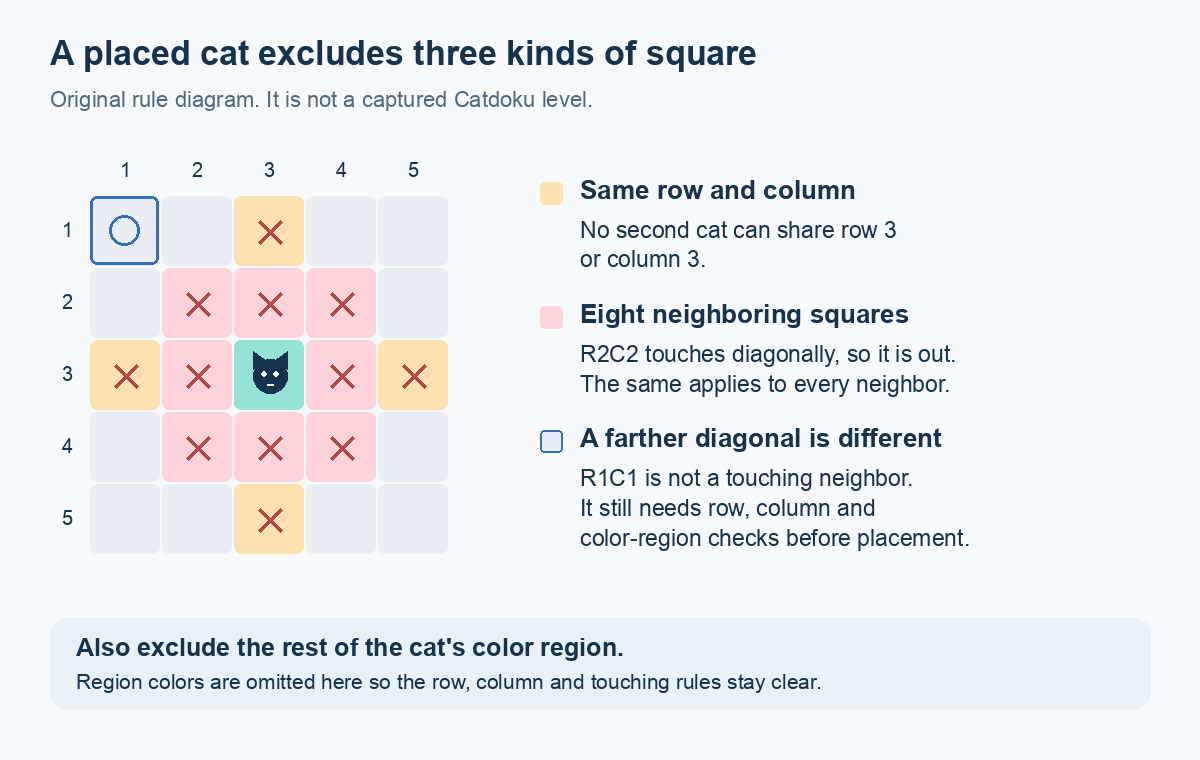
Suppose a confirmed cat is at row 3, column 3, written R3C3. Exclude the rest of row 3, the rest of column 3 and every other square in its color region. Also exclude its eight immediate neighbors. R2C2 is one of those neighbors, so it cannot contain a cat.
R1C1 is different. It lies on the same longer diagonal, but it does not touch R3C3. This rule alone leaves it undecided; its row, column, color region or another cat may still exclude it. Do not apply the full-diagonal attack rule from chess. The diagram omits region colors to isolate this distinction.
Example two: turn a pair of candidates into a deduction
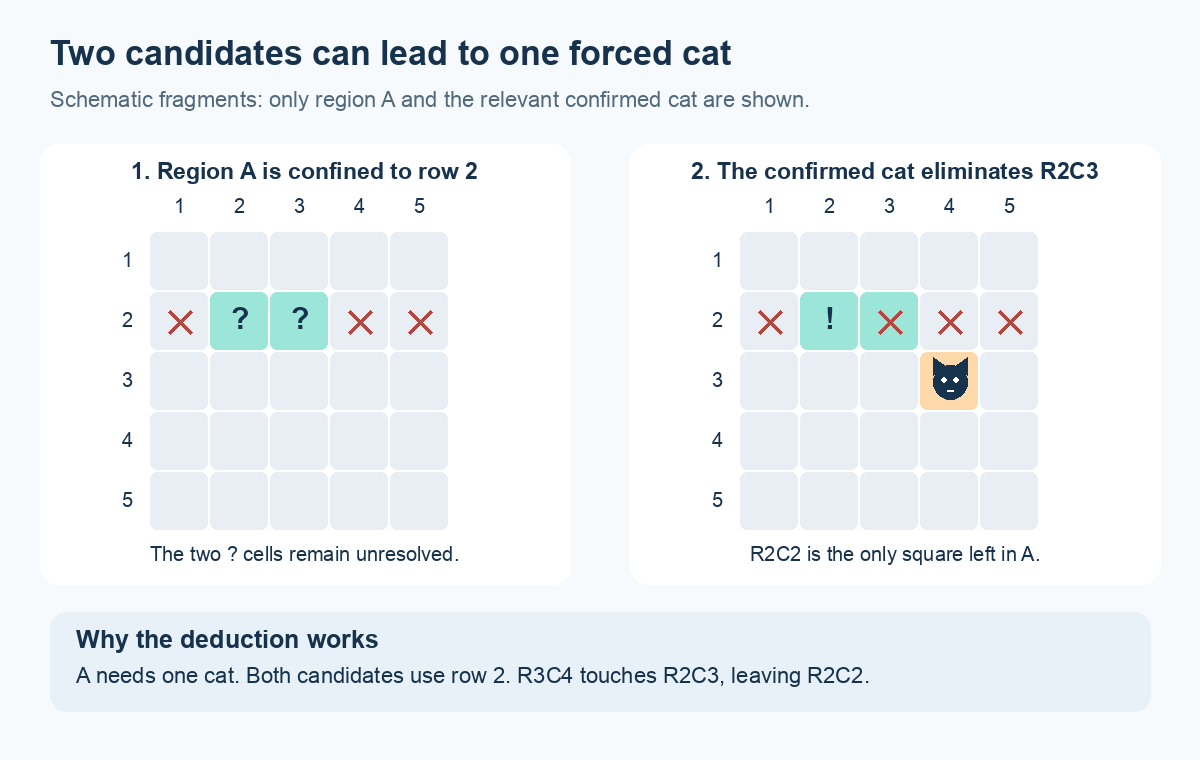
Imagine color region A has just two candidates left: R2C2 and R2C3. Whichever one holds the region’s cat, that cat will occupy row 2. Mark every other square in row 2 X. This is useful progress even though you have not chosen between the two candidates.
Now include a confirmed cat at R3C4. It touches R2C3 diagonally, eliminating that candidate. Region A still needs exactly one cat, and R2C2 is its only remaining candidate. R2C2 does not touch R3C4, so the local deduction forces the cat there. Check the rest of the actual board as you apply the reasoning.
The two diagram panels show the reasoning in stages. Uncolored squares stand for omitted regions and clues; this is a local demonstration, not a complete playable puzzle or a claim about a specific numbered level.
Scan the most restricted unit, then scan again
Look for a row, column or color region with very few candidates. One candidate gives a placement; two candidates sharing a row or column can give exclusions. After every confirmed cat, update its row, column, region and neighbors before looking for another placement.
If a region appears to have no candidates, recheck your X notes before guessing elsewhere. A mistaken exclusion can hide the only correct square. Ask what justified each X, and clear a note whose reason no longer holds. Bigger boards reward this same careful cycle rather than faster random tapping.
Use tools as explanations, then continue
The bulb offers a logical explanation when the current hint system can find one. Read the highlighted evidence and choose Apply to change the board. Closing the hint does not apply it, but the current build spends a Hint tool when an available hint opens. A supported hint is not guaranteed for every position.
The Cat tool automatically places a missing correct cat. Use it when you want help progressing, then inspect which rows and regions that placement affects. Complete the board and choose Next Level to continue. Try the two deductions in Catdoku, or find a different challenge among our puzzle games.
Common questions
Can Catdoku cats touch diagonally?
No. Immediate diagonal neighbors touch at a corner and are forbidden. The touching rule does not forbid every farther square on a long diagonal; other row, column and region constraints still apply.
Why can a cat placement be wrong without touching another cat?
The current game checks the intended solution as well as local conflicts. A cell that looks locally possible may prevent the rest of the puzzle from being completed, so try to prove a placement instead of guessing.
Can I solve Catdoku without using a tool?
The guide’s examples use only the puzzle constraints. Tools are optional help in the current game; they do not change the one-cat-per-row, column and region rules.
Are these diagrams answers to actual Catdoku levels?
No. They are original local teaching examples. They illustrate valid reasoning without claiming to be screenshots or solutions to particular numbered levels.