
How to play 2048: merges, moves and score
To play 2048, slide the board in one direction and merge equal numbers. Two 2 tiles make 4, two 4 tiles make 8, and the sequence continues until you create a 2048 tile. The important detail is that your move affects the entire board.
What happens in one move
Choose left, right, up or down. Every tile that can move slides toward that edge. Equal tiles next to each other in the direction of travel merge. After a successful move, a new 2 or 4 appears in an empty square.
In the FoolFish version, you can use arrow keys, WASD, touch swipes or the direction buttons. Start with a deliberate move and watch the whole grid before moving again.
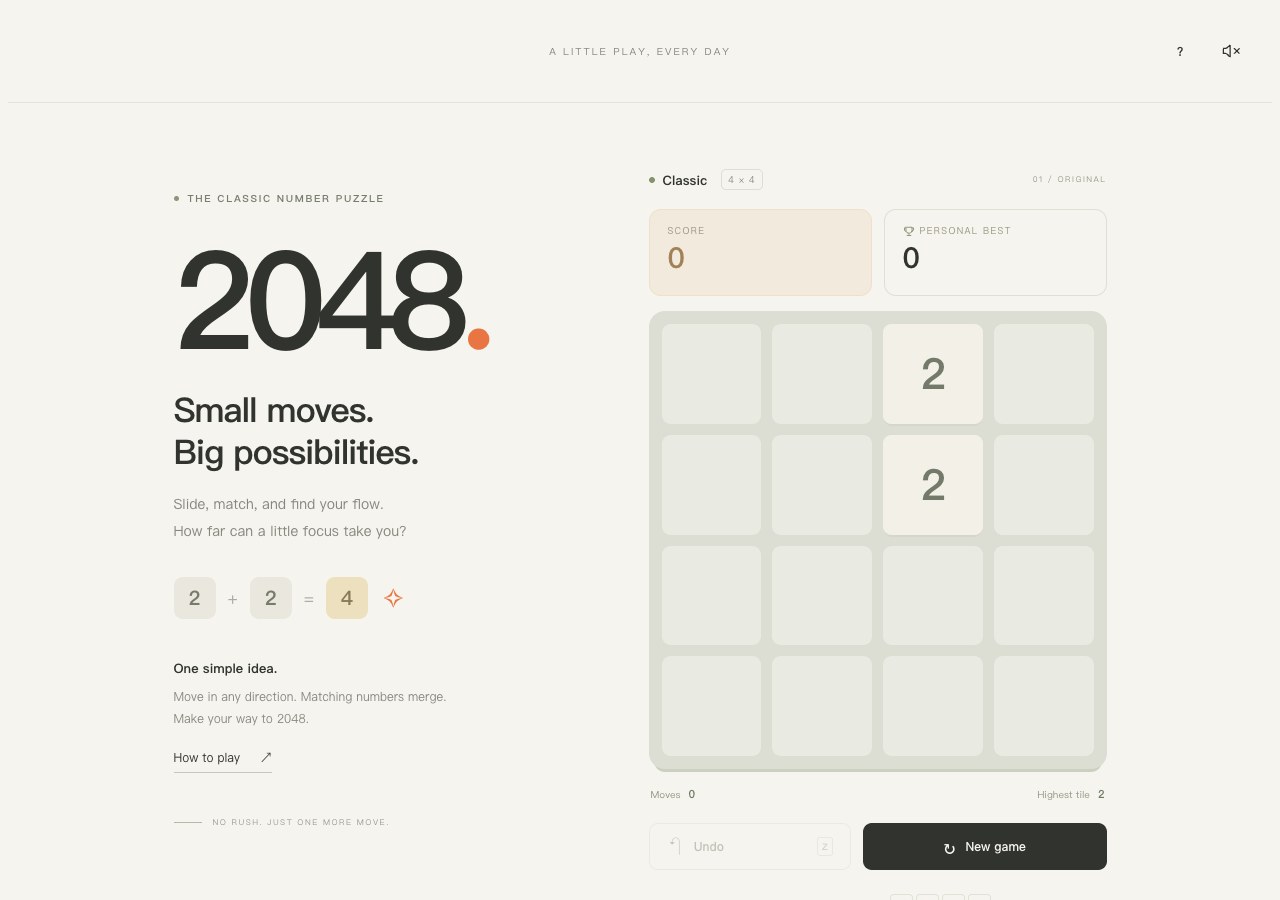
A row example: 2, 2, 4, 4
Imagine one row contains 2, 2, 4, 4 from left to right. Move left. The two 2 tiles merge into a 4; the two original 4 tiles merge into an 8. Before the new tile appears, the row is 4, 8, empty, empty.
The newly created 4 does not immediately merge with another 4 during that move. A tile can participate in only one merge per move. Another example is 2, 2, 2, 2: a left move produces 4, 4, empty, empty, not a single 8. A later move can merge those two 4 tiles.
Your score is different from your largest tile
The resulting value of each merge is added to your score. The 2, 2, 4, 4 example adds 4 + 8 = 12 points. Your total score can pass 2048 before you have a tile labeled 2048.
The target is the tile itself. The published game lets you continue beyond the target, but reaching it does not make every later position safe. You still need space and available merges.
A practical way to keep space open
Try keeping the largest tile near one corner, with smaller values arranged beside it in descending order. Before changing direction, check whether that move pulls the largest tile away or strands a small tile between larger ones.
A full board is not necessarily over: neighboring equal values may still merge. The board is stuck when no direction produces a move. Empty squares buy you options, so favor moves that leave a useful next merge rather than chasing the biggest immediate score.
This approach helps organize your choices but does not guarantee a win. New tile positions can make a promising layout awkward. Use Undo to study the previous position and compare what another direction would have changed.