
Factory Idle guide: balance inputs and plan your next Prestige
An idle factory can own plenty of machines and still make very little. The useful question is which input is limiting the next stage. This guide covers the six-tier, resource-pool Factory Idle on FoolFish Games. It uses a deliberately simplified rate calculation, then shows how to turn the diagnosis into a research or Prestige decision. It is not a conveyor-layout guide for another game with the same name.
Start with one small production goal
MINE begins by adding three ore per click. The first Drill costs 10 ore and has a base output of one ore per second. Use that opening to learn the difference between the stored amount and the rate beside it. A rising ore total tells you that supply currently exceeds consumption; it does not mean every later tier is ready.
The chain runs from ore to ingots, parts, circuits, cores and prototypes. Unlock a tier before expecting its machines to operate. For the full controls, unlock prices and save behavior, keep the Factory Idle game information nearby. Here the first goal is to understand one connection between tiers, rather than to buy every affordable machine.
Worked example: six ore cannot feed nine ore of demand
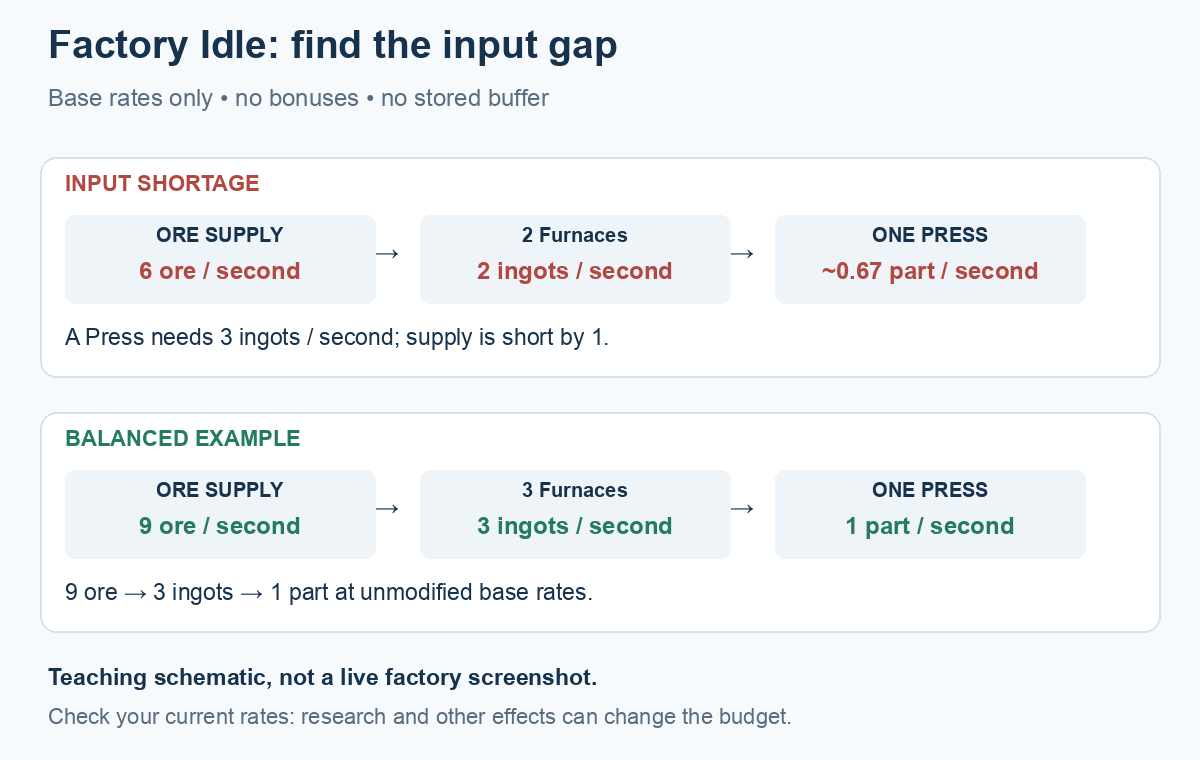
Consider the base machine rates with no research, supports, achievements, Challenge effects or temporary bonuses. A Miner produces 6 ore per second. Each Furnace consumes 3 ore per second to make 1 ingot per second. Two Furnaces therefore use the Miner's full supply and produce 2 ingots per second.
A Press consumes 3 ingots per second for a base output of 1 part per second. The example only supplies 2 ingots, leaving a gap of 1 ingot per second. With no stored buffer and no special effects, sustained output is about 2/3 of a part per second. Adding another Press cannot fill that input gap.
To balance one base Press, the example needs 3 ingots per second from three Furnaces, which in turn need 9 ore per second. One Miner plus three base Drills supplies that 9 ore. This demonstrates the rate relationship; rising purchase prices and your actual bonuses still decide whether that particular purchase is sensible.
Stored materials can hide a production gap
Suppose that short chain begins with a stored ingot buffer. The Press can temporarily draw the missing ingots from storage, making its output look healthy. Once the buffer is exhausted, input availability limits production. Watch the direction of the stored amount over several moments, then compare supply with consumption.
Trace the shortage upstream. If parts are short, check ingots; if ingots are short, check ore. A slow circuit tier might be a symptom of an ore shortage several stages earlier. Improve the earliest limiting input before paying for more potential output at the end of the chain. Special research can alter behavior under shortages, so use the actual machine indicators when your factory has advanced beyond this example.
Choose research that addresses the measured problem
A production upgrade increases supply at the stage it affects. An efficiency upgrade reduces input consumption. Those can both help a shortage, but their value depends on where the shortage occurs. Automation is useful for repeated buying; it does not by itself repair an input deficit.
Before buying a research node, write down its cost, the rate it changes and the tier you want to unlock next. Schematics spent on a convenience node are unavailable for that unlock. There is no universal best order independent of your saved research, current modifiers and target. Buy against a specific obstacle, then recheck the factory instead of assuming the previous bottleneck still dominates.
Prestige for a useful next run, not a bigger storage pile
The Schematic reward uses weighted production during the run, not just materials still in storage. Spending ore on machines does not erase the fact that the ore was produced. Read the displayed reward and choose a purpose for the next run: a tier unlock, an efficiency purchase or a production improvement you can afford with the resulting Schematics.
Prestige clears current resources, machines, supports and auto-buy switches while retaining research, Schematics and tier unlocks. Publish is a separate, deeper reset available after producing at least one Prototype; it also clears Schematics, research levels and tier unlocks in exchange for Patents. Read each confirmation. Neither button is the full Reset Game command in Settings.
Save before ending a session or switching devices. Guest progress stays in this browser; signed-in sessions can use account checkpoints. The factory's offline catch-up has an eight-hour base cap, with extensions from permanent upgrades. An idle-game label does not mean unlimited offline accumulation.
Use a short check after each major purchase
Read one downstream demand, find its upstream supply and inspect whether storage is rising or falling. After research or a new machine changes those rates, do the check again. This turns Factory Idle strategy into a series of small, testable decisions rather than a fixed machine list.
Return to Factory Idle to try the rate budget. Fish Factory uses the same economy with an ocean theme and a separate save slot. For a different incremental loop, browse free clicker games.
Common questions
Why did my Factory Idle output fall after running smoothly?
Stored input may have covered a production deficit. When that buffer runs out, the machine becomes input-limited. Trace the missing resource upstream and compare current supply with consumption.
Is one Miner always enough for two Furnaces?
At the unmodified base rates, a Miner makes 6 ore per second and two Furnaces consume 6. Research and other effects can change either side, so check your live factory before treating the example as a purchase plan.
Does spending materials reduce my Prestige production score?
The reward uses weighted materials produced during the run, not only the current stored amount. Read the displayed Schematic gain and use it to plan a useful next run.
Is this a Factory Idle conveyor guide?
No. It covers the FoolFish Games resource-pool edition with six material tiers. Instructions for drawing conveyors in a different similarly named game do not apply.