
Fish Sudoku Idle guide: Sudoku for beginners and a happy aquarium
Fish Sudoku Idle combines free browser Sudoku with a cartoon aquarium that keeps earning as you solve. This guide covers version 1.0.0 of the FoolFish Games title, from its playable beginner lesson to coral upgrades and away earnings.
How to play Fish Sudoku Idle: the first three moves
Begin with the guided lesson rather than a blank 9x9 board. The tutorial uses a 4x4 grid and introduces rows, columns and boxes one at a time. Tap the glowing cell and then the highlighted number. You do not need to do arithmetic: Sudoku is about where numbers can go.
The first row reads 1, empty, 3, 4. A 4x4 Sudoku row must contain 1, 2, 3 and 4 exactly once, so the gap is 2. Next, the highlighted column contains 3, empty, 4, 2: its gap is 1. Finally, the bottom-right 2x2 box already contains 4, 1 and 2, leaving 3 for its last cell.
After those three moves, select Start my reef. Pip joins the aquarium, you receive 30 shells, and idle production begins at one shell per second. This is the handoff from the teaching board to your first independent puzzle. You can replay the lesson from the question-mark button without resetting your fish or coral.
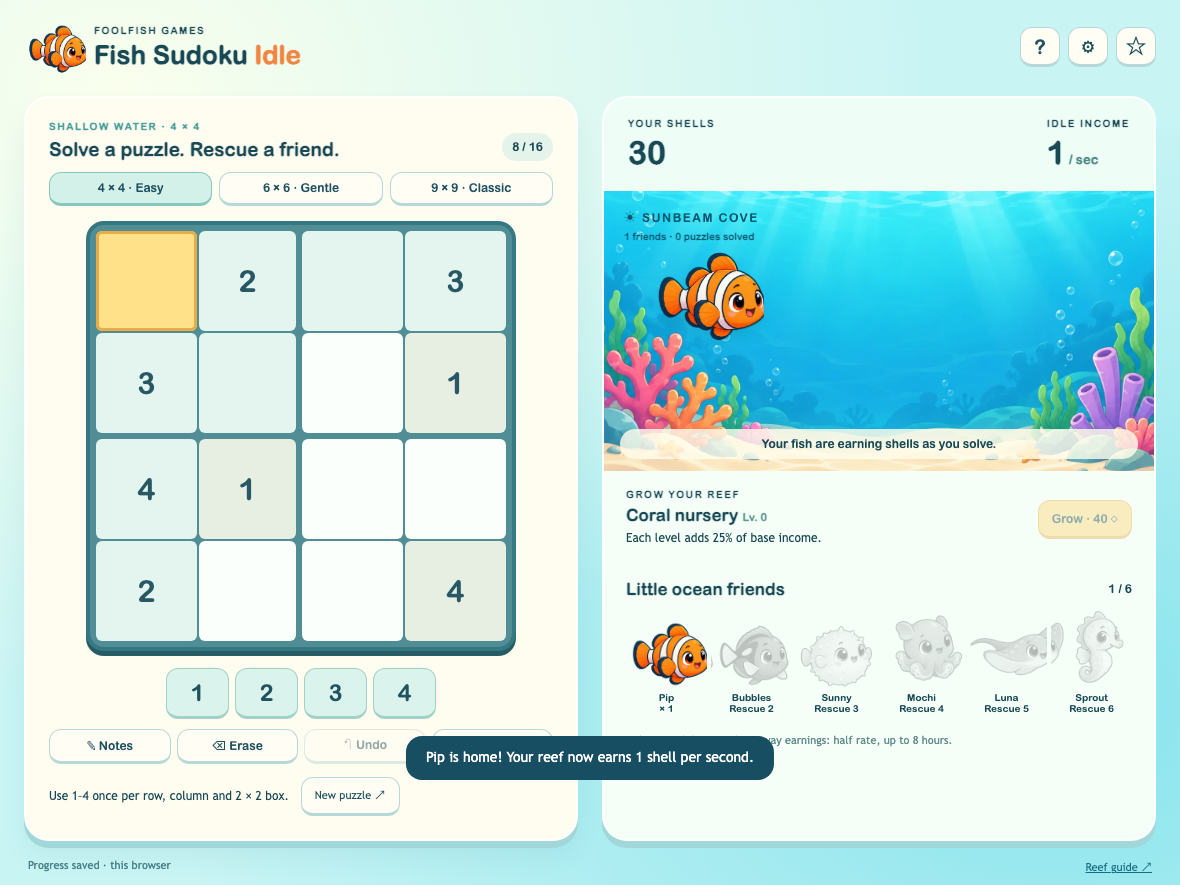
4x4, 6x6 or 9x9 Sudoku: choose the right next step
All three sizes are available after the lesson. Start with 4x4 Sudoku when you want fewer possibilities to track. It uses numbers 1–4 and 2x2 boxes. Finishing a board awards 30 shells and rescues one friend.
6x6 Sudoku is a useful bridge for beginners: use numbers 1–6, with boxes that are two rows tall and three columns wide. The rectangular boxes are easy to misread at first. Follow the heavier boundaries, not an imaginary 3x3 square. A completed board awards 90 shells and one friend.
Classic 9x9 Sudoku uses numbers 1–9 and 3x3 boxes. Each completed board awards 200 shells and one friend. Every generated board in this version is checked for a unique solution and a path using single-candidate deductions. The larger board gives you more to scan, rather than introducing advanced techniques.
Choose a board you enjoy finishing. A 9x9 win has a larger shell reward, but it is not automatically the fastest way to rescue fish: each size gives exactly one friend per completion. Switching away from a partly filled board asks before replacing it; your aquarium stays intact.
A beginner Sudoku strategy: find one forced cell
Start with a row, column or box that has only one or two gaps. List the missing numbers, then check the other two constraints for each empty cell. A placement must satisfy its row, its column and its box at the same time.
For example, a row in a 4x4 board contains 1 and 4, so its two gaps need 2 and 3. If the column through the first gap already contains 3, that gap must be 2. The remaining gap in the row must then be 3. This little chain is more reliable than choosing the number that merely looks plausible.
After placing a number, scan the row, column and box it touches again. Your move may have reduced another cell to a single option. Repeat this loop before searching elsewhere. If you cannot find a forced cell, add notes rather than guessing.
Red cells show a repeated number in a row, column or box. A cell staying blue does not prove the answer is correct: a wrong guess can fit the visible constraints for a while and cause a dead end later. Undo is useful for revisiting that decision.
Notes, Undo and hints: what each button does
Select Notes to pencil in possible numbers. Tap an empty editable cell, then a number to toggle that candidate. Notes do not count as a completed answer. Turn Notes off to place the final number; erase an existing answer before adding notes there.
Erase clears the selected editable cell. Undo restores the previous cell entry or note change. These tools are free. The fixed starting clues cannot be edited. On a keyboard, use number keys to enter values, arrow keys to move selection, Delete or Backspace to erase, and N to toggle notes.
A hint costs 20 shells and fills the selected cell with its correct answer. If that cell is a clue or already correct, the game chooses another unfinished or incorrect cell. A hint also exits Notes mode. Read the surrounding row, column and box after using it so that it teaches you something useful.
If a board looks finished but no reward appears, check for red duplicates and compare your recent placements. The reward arrives only when the whole board matches its unique solution.
How the idle aquarium earns shells
Pip is your starter friend. Completing further puzzles rescues Bubbles, Sunny, Mochi, Luna and Sprout, then cycles through the collection again. Duplicate friends still contribute income even though the aquarium displays one character image per discovered species.
Every friend contributes one shell per second before coral bonuses. Reef income is: total friends × (1 + 0.25 × coral level). Three friends with level-two coral therefore produce 3 × 1.5 = 4.5 shells per second. That income continues while you work on another Sudoku board.
The first coral upgrade costs 40 shells. Later costs grow by a factor of 1.6 per level, rounded up: the second costs 64, the third 103. Each upgrade adds 25% of base production; it does not multiply the previous total by 1.25. Coral has 50 levels in this release.
This connects the puzzle and idle sides: Sudoku grows the number of earning friends, while coral makes all those friends more productive. You do not need to tap the fish repeatedly or switch to a separate minigame.
Should you upgrade coral or spend shells on a hint?
If you are solving comfortably, early coral upgrades are useful because they apply to every current and future friend. With two friends, the first 40-shell upgrade adds 0.5 shell per second. It pays back its cost in 80 seconds of active production, assuming your friend count stays the same.
If you are stuck, a 20-shell hint can be worth more than waiting for a larger balance. Completing the puzzle earns its shell reward and adds another productive friend. Use Notes first, then buy a hint when it helps you understand a constraint you missed.
These are choices, not a mandatory build order. There is no countdown or limited life supply. You can play a quick 4x4 board, work steadily through 6x6, or enjoy a longer 9x9 puzzle while the reef earns in the background.
Away income and keeping your reef safe
Away earnings use half the reef production rate saved when you leave, for up to eight hours. A reef producing four shells per second earns 7,200 shells during a one-hour absence: 4 × 0.5 × 3,600. Eight hours or longer earns at most 57,600 at that rate. Reopening the same save does not claim that interval again.
Guest progress is stored in the current browser. When the FoolFish platform enables account saving for a signed-in session, the game uses the account checkpoint. Save & settings shows which mode is active. Do not assume a guest reef has automatically moved to another browser.
Use Download save backup before clearing browser storage or changing devices. Restore a backup validates the file and asks before replacing the current reef. If two devices have different account saves, choose the version you want to keep when the conflict prompt appears.
Is “fish Sudoku” a game or a solving technique?
On this page, Fish Sudoku Idle means the cartoon aquarium game made by FoolFish Games. In other Sudoku discussions, “fish” can refer to advanced candidate patterns such as X-Wing and Swordfish. Those are a different search intent.
You do not need fish-pattern techniques to play these generated boards. This guide focuses on how to play the game, use beginner deductions, and grow its idle aquarium. Start the actual game at Fish Sudoku Idle.
More relaxing puzzle games on FoolFish
For another connected reef-building system, try Fish Playground Idle, which combines water routing with fish merging. If you prefer a sliding number board, try Fish 2048. Browse the puzzle games collection for more logic games, or the idle and clicker collection for longer-running growth systems.