
How to play one-suit Spider Solitaire: rules and strategy
A neat run of cards is useful, but an empty column may be worth more. One-suit Spider Solitaire asks you to balance tidy sequences with access to the cards underneath. Choose 1 Suit in the FoolFish game to follow this guide.
One-suit Spider Solitaire rules
The board has ten columns. Build downward by rank: a 9 can go onto a 10, an 8 onto a 9, and so on. You may move a face-up card or a correctly ordered sequence onto a card one rank higher. An empty column can receive any movable card or ordered sequence.
In one-suit mode, the cards are all spades. Complete a sequence from King down to Ace to collect it. Remove all eight complete sequences to win. You do not need the extra suit-management rules used in two-suit or four-suit Spider.
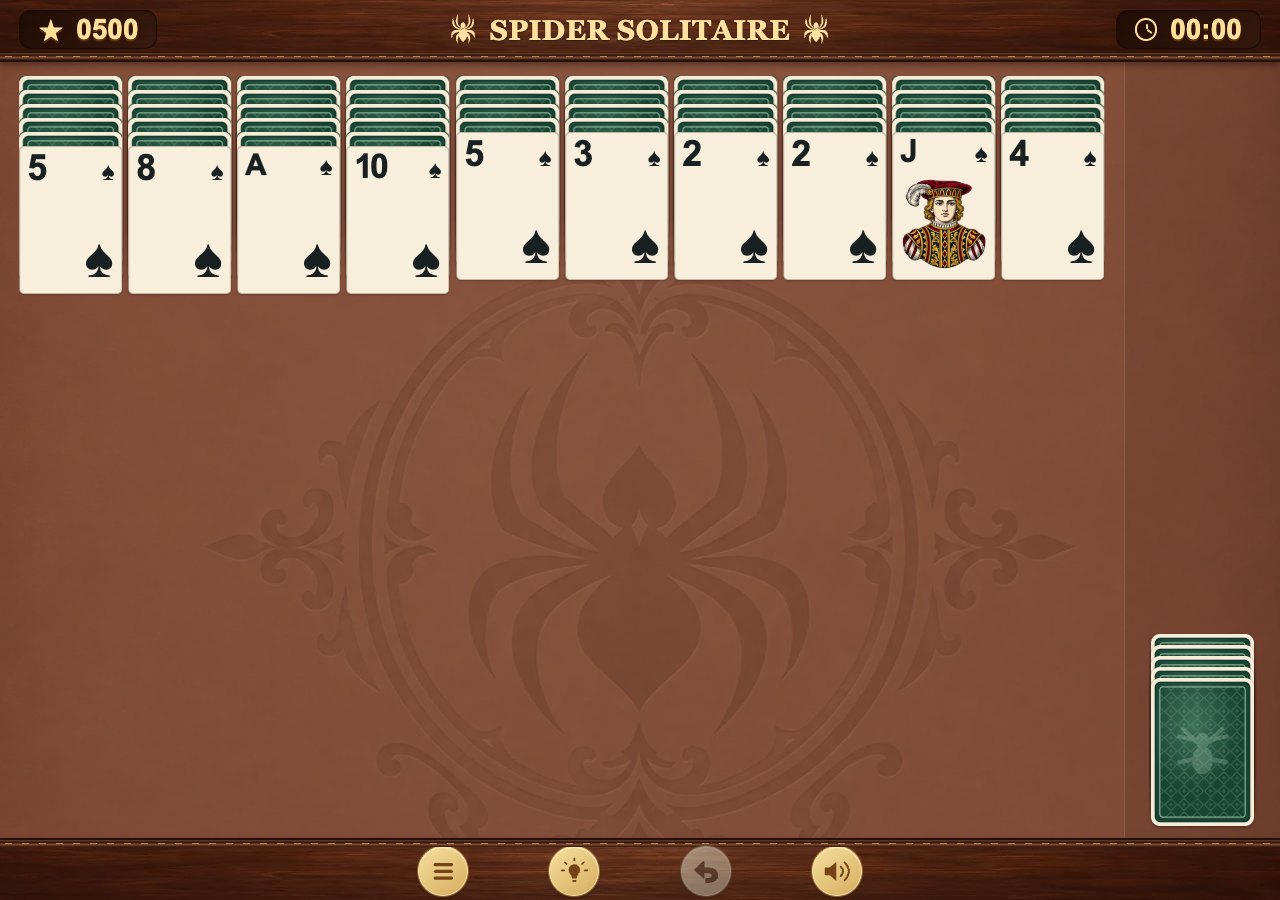
Moving a run: 9, 8, 7 onto a 10
Suppose one column ends with a face-up 9, 8, 7 in that order, and another ends with a 10. Move the run starting at the 9 onto the 10. The whole ordered run moves together. You have extended the destination sequence and may have improved access to the source column.
Clicking or tapping a card chooses a valid destination automatically. If more than one destination is available, clicking the same card again can try another. Dragging lets you choose the destination yourself. Use that control when a particular source or empty column matters to your plan.
Why empty columns matter
An empty column is temporary working space. It lets you move a sequence out of the way, reach a useful card, and rebuild the run in a better place. Before filling it, look for a move that will free another column or uncover more of the tableau.
For example, putting a long sequence in your only empty column may look tidy but leave a buried connecting card inaccessible. Compare that move with using the space briefly to separate two runs. A useful Spider Solitaire strategy is to ask what the move exposes, not just how many cards it joins.
Before dealing from the stock
Select the stock at the top right to deal one new card onto every column. Every column must contain a card before a deal is allowed. If the stock will not respond, check for an empty column before assuming the game has stalled.
A deal changes all ten column tops. First inspect the legal moves already available, especially moves that uncover cards or finish a sequence. Sometimes dealing is necessary; it should be a considered change of position rather than a reflex whenever the board looks awkward.
Hints, undo and score
Each move or deal costs one point, and each completed sequence earns 100 points. Undo costs an additional point and removes any completion reward associated with the action being undone. Returning to an earlier board can therefore change the score as well as the card positions.
Hint highlights a possible move, but that does not establish the best long-term plan. Use it to find a starting point, then inspect the source and destination. Your current game is saved locally in the browser; clearing site data can remove that local position. There is no need to rush a difficult deal.
Common questions
Can any card go into an empty column?
Yes. In this release, an empty column accepts any movable face-up card or ordered sequence; it is not restricted to Kings.
Why can I not deal more cards?
The stock requires a card in every column. Fill empty columns with legal moves before dealing.
Does this guide explain four-suit Spider Solitaire?
This guide focuses on the 1 Suit option. The game also displays 2 Suits and 4 Suits challenges; their extra suit-management decisions are not covered here.