
Water Sort puzzle: rules, empty cups and better pours
An empty cup looks like unused space. In Water Sort, it is often the most useful thing on the board. The trick is to spend that space on a pour that uncovers another color, then earn the space back.
Water Sort rules: what can you pour?
Select a source cup, then a destination. The destination must have room and must either be empty or show the same color on top. You cannot pour blue onto a red top layer just because another blue layer is visible farther down.
Each cup in this game holds four layers. Connected layers of the same color at the top move together, limited by the space available in the receiving cup. You are reorganizing stacks, not choosing individual layers from the middle. A level is complete when every non-empty cup is full and contains a single color.
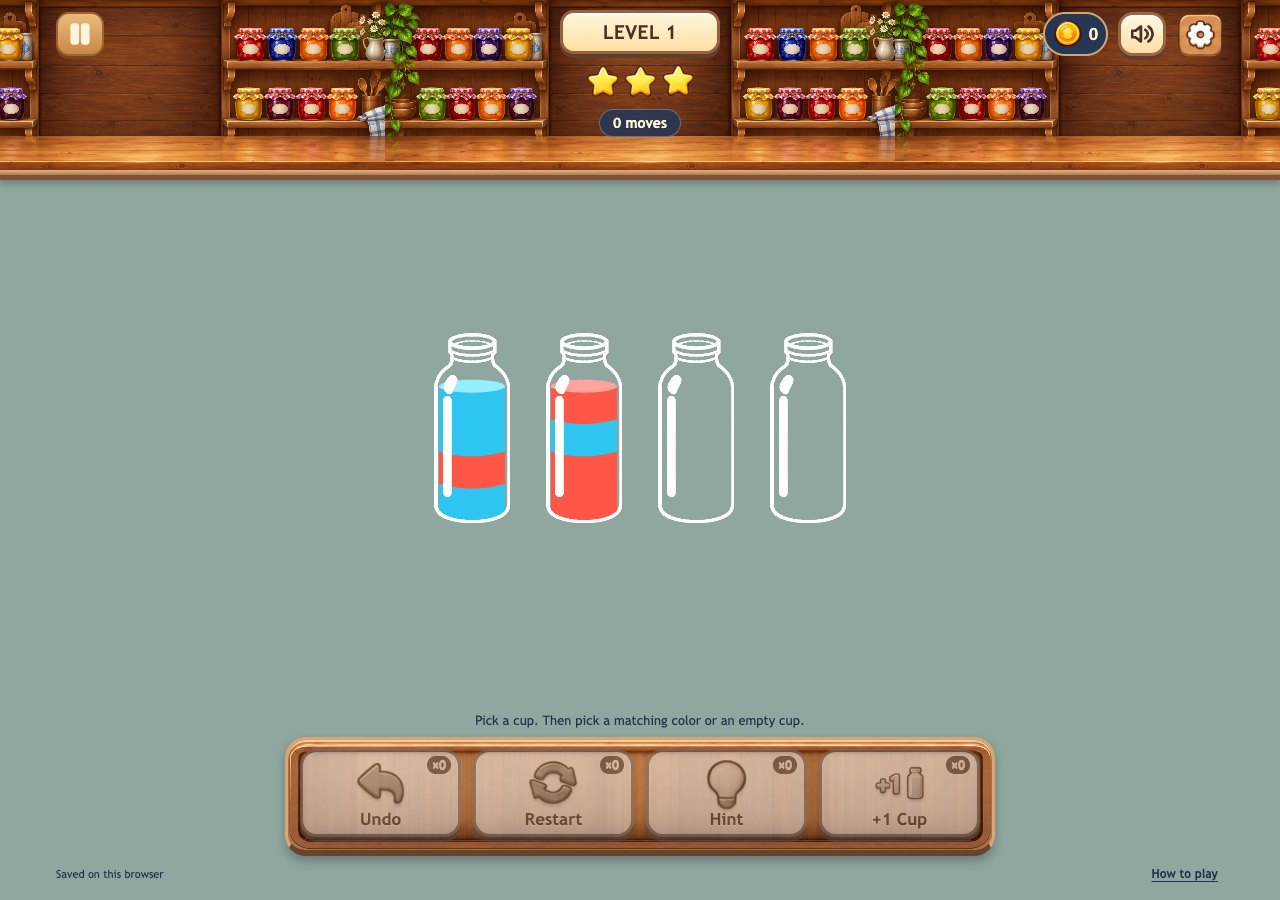
A worked pour: two blue layers, one empty space
Imagine a source with two blue layers on top of red. Another cup has three blue layers and one empty space. Pouring into that cup moves one blue layer, because that is all it can hold. The source still has blue on top, so its red layer is not available yet.
Pour those same two blue layers into a completely empty cup and both can move. Red is now exposed in the source, but you have used an empty destination. Neither move is automatically best: compare what each resulting position lets you do next.
Water Sort strategy: make empty space work twice
Before using an empty cup, name the next pour you hope to unlock. Moving a top group to expose a matching color can create a useful chain. Moving it merely because a cup is empty can leave several half-finished piles with nowhere to put the next color.
A good sequence often combines matching tops, empties a source cup, and reuses that source for a different blocked group. Count free layers as well as empty cups. A cup with one spare layer and a compatible top can be valuable even when the board has no completely empty cup.
Why a legal pour can still make things harder
Combining colors is helpful when it opens another move. It can be unhelpful when it fills the only destination needed to uncover a buried color. Look beneath the group you are about to move and check whether the newly exposed top will have somewhere to go.
A cup containing only one color is not necessarily finished. If it is partly full, the completion rule still requires the remaining layers. Avoid treating every single-color cup as permanently out of play while other cups remain mixed.
Use a hint to study the next decision
Undo, Hint and the extra-cup control offer different ways to recover when available. Undo lets you revisit a decision; a hint gives you a possible next action; extra space changes your options. Check the controls shown in your current round rather than assuming that every tool is always available.
Blind Mode hides lower colors, so you cannot plan from information that has not been revealed. Learn the visible-color rules first. If distinguishing similar colors is difficult, the game also offers color numbers in Settings. Judge your progress by the choices you understand, not only by how quickly the liquid moves.
Common questions
Why will a cup not pour?
Check the destination’s top color and remaining space. Only a compatible top group can move; a matching color buried lower down does not count.
Do all cups need to be full to win?
Empty cups may remain. Every non-empty cup must be full and contain one color.
Is there one Water Sort solution for every level number?
No. Different games and versions can use different layouts. This guide explains the rules of the FoolFish release rather than claiming universal level-number answers.