
CatClash match-3 guide: specials, boxes and rescue goals
A cascade can look impressive and still miss the goal. In CatClash, first read what the level needs: fish treats, cleared boxes or rescued cats. Then choose matches that move that particular task forward.
The first swap: how this cat match-3 game works
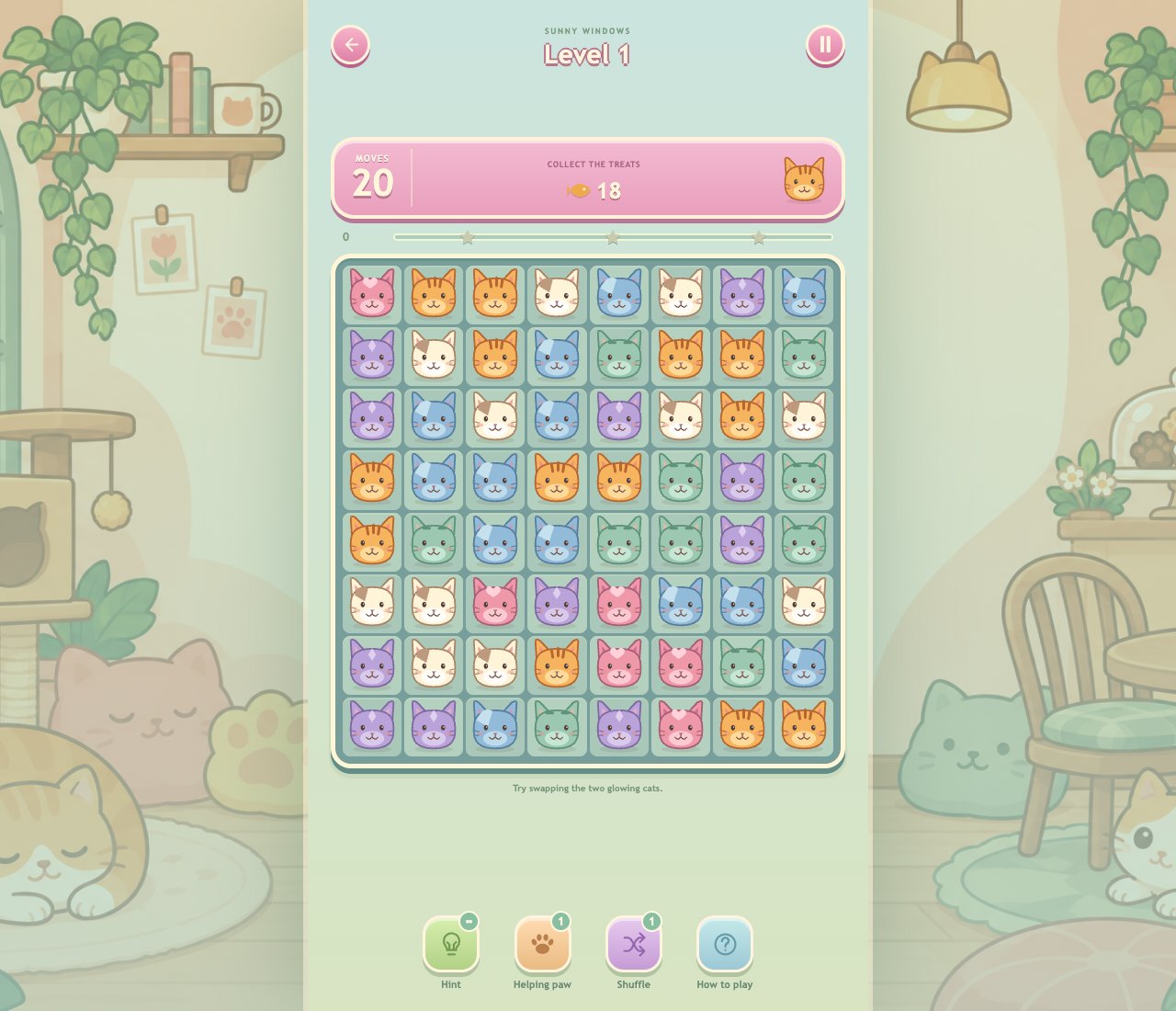
Swap neighboring cats by tapping two tiles or swiping. Three or more identical cats in a row or column make a match. The matched tiles clear, allowing the board to change and sometimes produce a cascade of further matches.
Each level has goals and a move limit. Complete every goal before the available moves run out. Matches over boxes remove their layers and free trapped cats, so the location of a match matters. Read the remaining goals again after a large cascade rather than assuming that it finished everything.
Four cats, five cats, and T or L shapes
A match of four creates a line-clearing paw. A T or L match makes a yarn bomb. Five matching cats in a straight line create a rainbow bell. These patterns turn ordinary swaps into more powerful tools, and combining two specials produces a larger clearing effect.
Before completing an obvious three-cat match, check whether a different neighboring swap forms one of those shapes. Also check where the resulting special can help. A special created close to an unfinished goal may be more useful than one made in an already clear part of the board.
A decision near a layered box
Suppose you can clear three cats in an open corner or make a match over a box that still covers a trapped cat. If rescue is the remaining objective, the box match directly advances it. The corner match may add score or cause a useful cascade, but that outcome needs a reason; it should not be assumed.
When a box has several layers, one relevant match may not finish the job. Keep a route to it available. Look for a nearby special or a second match you can set up instead of spending your final moves on unrelated tiles.
Choose the tool that addresses the problem
Helping Paw clears a chosen tile, Shuffle rearranges the board, and Hint highlights a possible move. Those are different jobs. A targeted clear can help with one awkward position, while a shuffle changes the whole set of opportunities. Check the current availability of a booster before planning around it.
A hint is useful when you cannot see a legal swap. It is not a guarantee that the highlighted swap will finish the level. After using a tool, pause to read the new board: a cascade may have changed both the remaining goals and the best next move.
Attempts, energy and returning to a round
A new attempt costs one energy. Energy recovers by one every 30 minutes, up to ten; resuming an unfinished round is free. That makes continuing a current attempt different from starting it again. Check whether you are resuming or restarting before leaving a difficult board.
For a simple improvement habit, spend the first moment of each turn on the goal display and the last on the move counter. You are deciding where a swap helps, not merely where three matching cats happen to be lined up. These rules describe the CatClash release available on FoolFish.
Common questions
How do I create a yarn bomb?
Make a T-shaped or L-shaped match.
Why is a trapped cat still there after a match?
Its covering box may have more layers. Keep making relevant matches over it and check the remaining goal.
Does resuming an unfinished round cost energy?
No. A new attempt costs energy, while resuming an unfinished round is free.