
How to play mahjong solitaire: rules with tile examples
To play mahjong solitaire, remove two matching tiles at a time until the board is empty. Each tile must be uncovered and have an open left or right side. Those two checks explain most of the moments when a pair looks right but cannot be played.
First, which kind of mahjong is this?
This guide explains mahjong solitaire, the single-player tile-matching puzzle used in Mahjong Clearer. You look at a board of tiles, choose legal pairs, and remove them. You are not building a hand against opponents.
If you came looking for traditional multiplayer mahjong, the rules are different. That game includes drawing and discarding tiles and evaluating hands. You do not need those rules, scoring tables, or the names of every symbol to follow this solitaire guide. Here, start by comparing tile faces and reading their positions.
1. Find two tiles with the same face
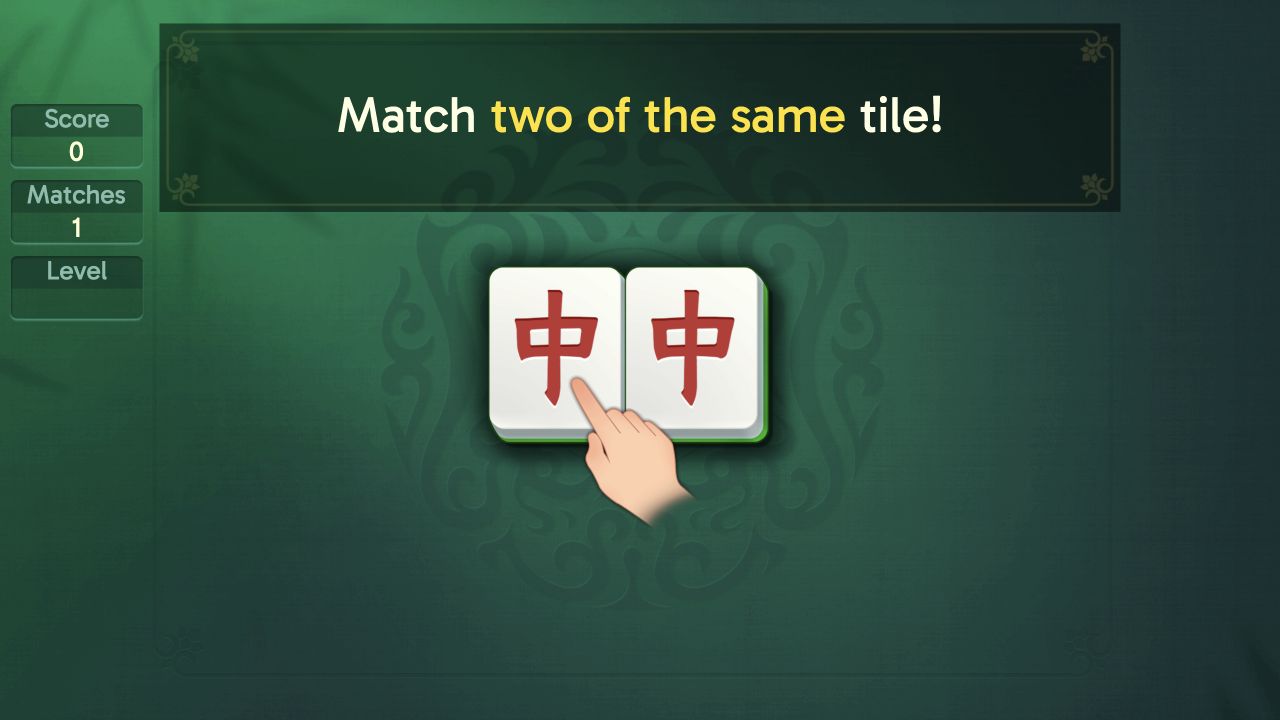
Look for two tiles whose designs match. Compare the whole face, including the shape and arrangement of its marks. A similar color alone is not enough. In the first Mahjong Clearer tutorial, both tiles carry the same red symbol, making the match easy to recognize.
Select one tile with a click or tap, then select its matching partner. The pair can disappear only if both tiles are available. It does not matter how far apart they are: this is not a connect game where you must draw a clear line between them.
2. Check that neither tile is covered
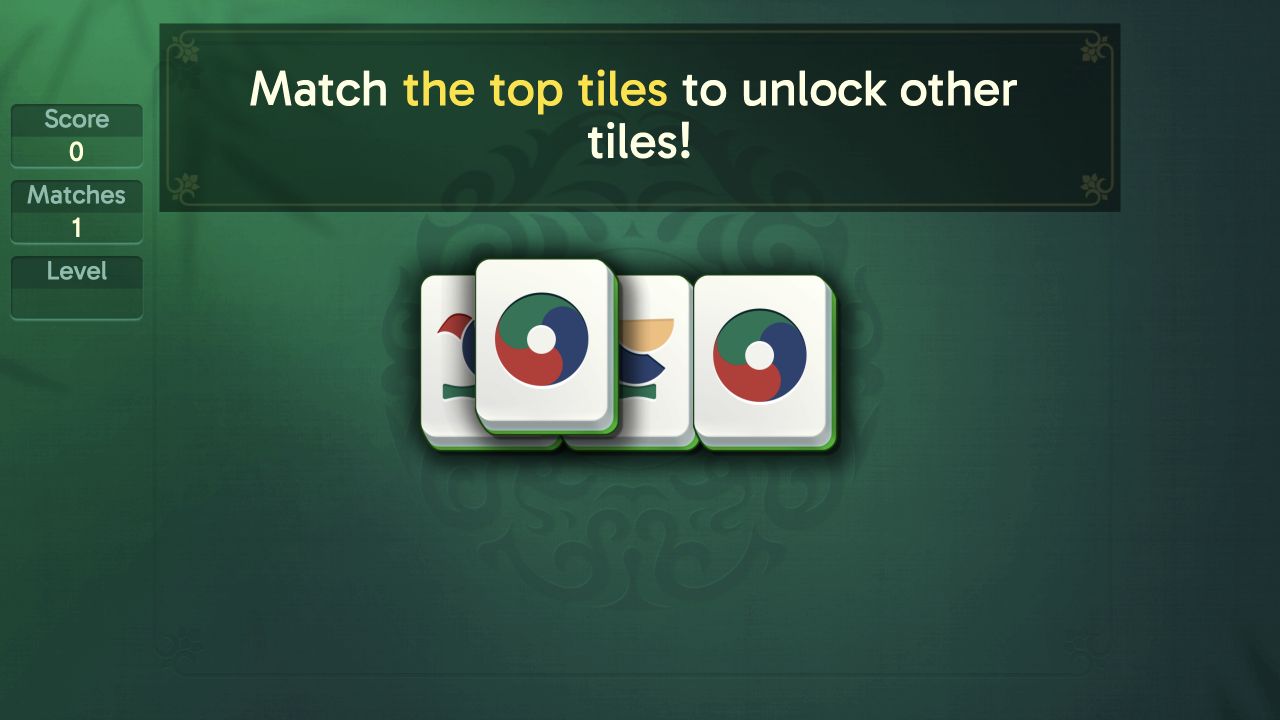
A tile with another tile on top of it cannot be removed yet, even if you can see part of its face. Look for an overlapping edge or a tile raised above it. Clear the covering tile as part of its own available pair first.
In this screenshot, the circular-symbol tile sits across the bird tiles. Its matching circular tile is available beside the stack. Removing the circular pair reveals the birds. A tile being near the top of the screen is not the same thing as being on top of another tile; check the overlap.
3. Check for an open left or right side
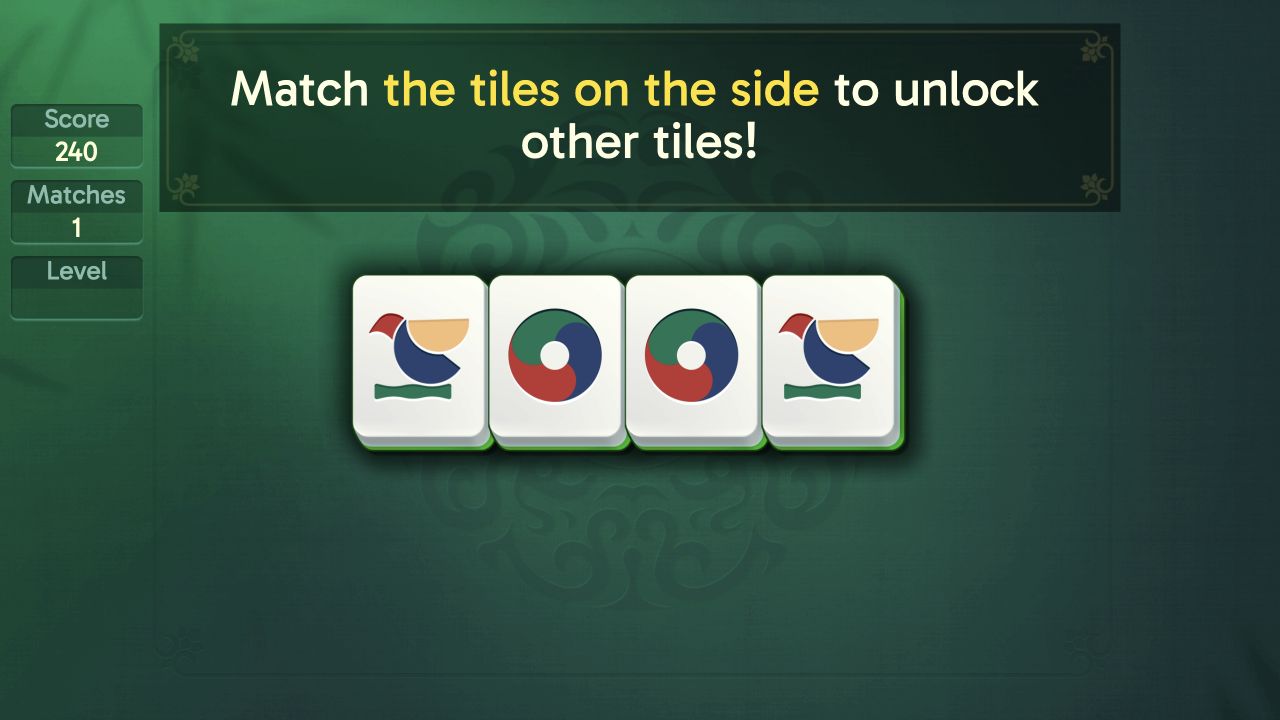
An uncovered tile still needs room on at least one horizontal side. If neighboring tiles block both its left and its right, it is not available. One open side is enough; both sides do not have to be clear. Space above or below a tile does not replace this condition.
The row below is a useful example. The two bird tiles at the ends match, and each has an open outer side. The circular tiles in the middle also match, but both are blocked by neighbors. Remove the birds first to free the circular pair.
4. Repeat after every pair
Removing a pair changes the board. A previously covered tile may now be visible, or a row may have a new exposed end. Instead of returning automatically to the next match you noticed earlier, check the places your last move opened.
For each candidate pair, ask the same three questions: do the faces match, are both tiles uncovered, and does each have an open horizontal side? If all three answers are yes, it is a legal pair. Keep removing pairs until the board is empty. Smaller teaching examples and larger boards can have different tile counts; the objective stays the same.
When a matching pair will not work
Do not keep clicking the blocked tile. Find the pair that removes its cover or the neighbor at the end of its row. If you have overlooked a legal pair elsewhere, use Hint to get another starting point.
- Check both tiles. One free tile does not make its blocked partner available.
- Look for a slight overlap. A tile can cover only part of another face and still prevent its removal.
- Check left and right, not top and bottom. A gap along the top edge does not necessarily free the tile.
- Compare the full design again. Two faces can look similar at a glance without being the same.
Hints, shuffle, undo and the end of a board
Mahjong Clearer includes hint, shuffle and undo controls. A hint points out an available match. Shuffle changes the arrangement of remaining tile faces. Undo lets you revisit a recent choice. These tools are useful for learning, but they perform different jobs: a hint does not remove the blockers around the tile you wanted.
If there are no available matches, inspect your recent decisions and consider undo or shuffle. Clearing a board depends on the layout and the choices you make; seeing a legal move now does not prove that every later move will be possible. When the final pair is removed, that board is complete.
Try a short practice routine
This simple routine turns the free-tile rule into a habit. Once selecting legal pairs feels natural, the next challenge is choosing between several legal pairs. Our strategy guide builds on these same examples without changing the rules.
- Before your first click, identify one uncovered tile on the edge of a row.
- Find its matching partner and check that tile separately.
- Name what your pair will uncover or free before you remove it.
- After the pair disappears, compare your prediction with the board.
Common questions
What are the basic mahjong solitaire rules?
Remove two matching available tiles at a time. Each tile must be uncovered and have at least one open left or right side. Clear the board to finish.
Can I match two tiles in the middle of a row?
Only if each is uncovered and has an open horizontal side. A tile blocked on both its left and right cannot be used, even when its face is visible.
Can I play mahjong solitaire by myself?
Yes. It is designed for one player. No opponent, draw pile or multiplayer lobby is needed in Mahjong Clearer.
Do all mahjong solitaire games use identical tile rules?
No. Tile sets and special matching rules can differ between games. This guide describes the matching, covering and side-access rules shown in Mahjong Clearer; check another game’s instructions before assuming every special tile behaves the same.