
Fish eat fish: the interesting choice is when to turn away
A closer look at fish-eating games: readable danger, room to escape and touch controls. Explore the blue-ocean arcade concept we are planning at FoolFish.
- 01Read the sizeSpot prey and predators.
- 02Leave a way outA meal is not worth a dead end.
- 03Grow, then reassessThe safe route can change.
A small fish in a crowded sea
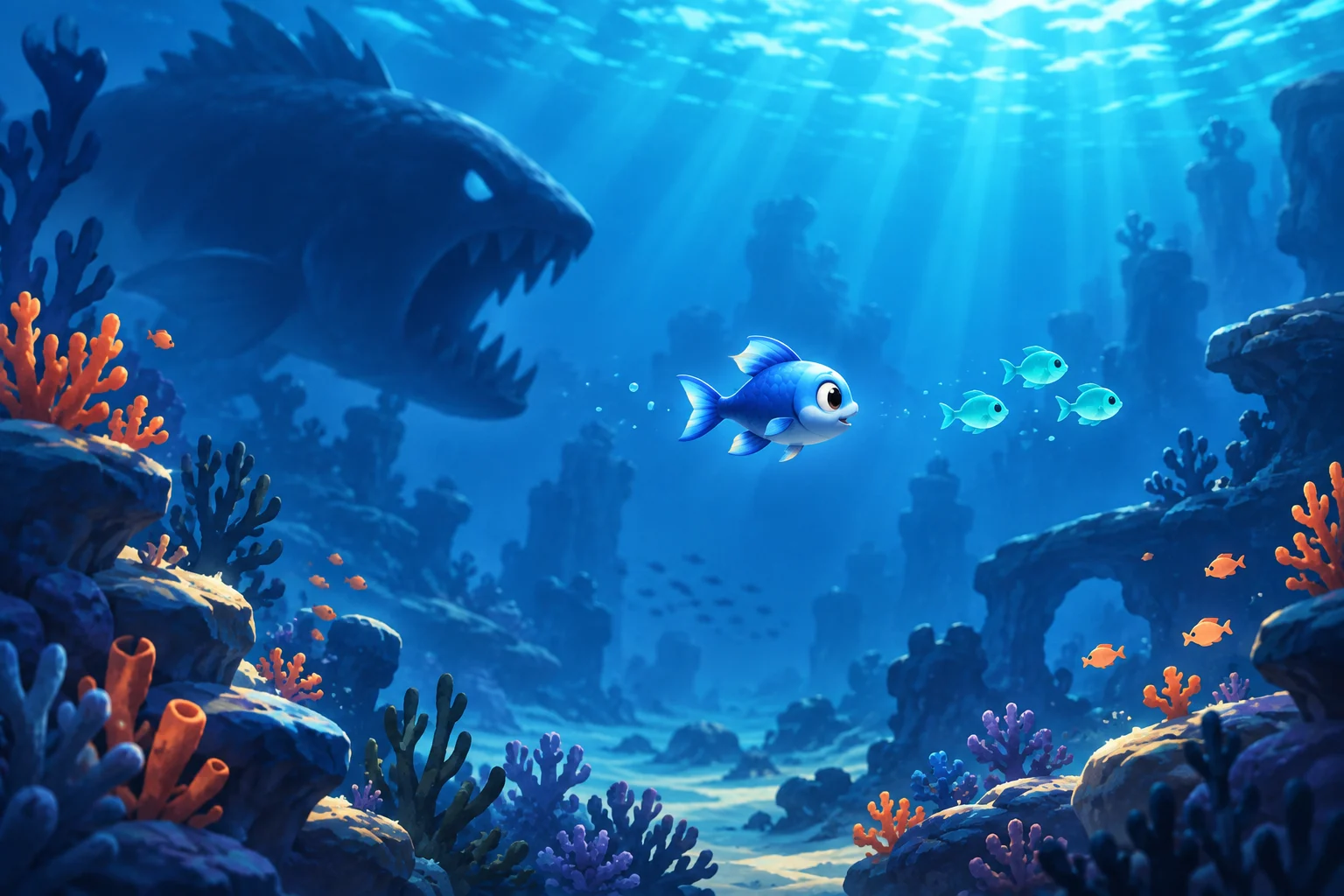
A tiny fish is drifting into reach. Behind it, a much larger fish crosses your route. You could chase the easy meal, but the trip back is no longer clear. The best move might be to turn away.
Fish-eating games build a surprisingly good decision out of a simple rule: eat something smaller; avoid something bigger. Growth changes which creatures are safe to approach. The same route that felt comfortable a moment ago can become dangerous when a new silhouette enters the screen.
Three things a player must be able to read
Our fish eat fish concept starts with visibility. Deep-blue water gives the scene its identity, but the playable space cannot disappear into decoration. A coral branch that looks like an obstacle should not secretly be a harmless background shape.
- Size: the difference between prey and danger should be visible without stopping to inspect a number.
- Direction: a fish needs enough visual lead-in for the player to read where it is heading.
- An exit: a tempting meal should not hide every route away from the next predator.
Follow one possible encounter
In the proposed loop, your blue fish approaches a small school near the centre. A broad indigo silhouette enters from the right. Its arrival would be signalled before it overlaps the player, giving you time to choose: follow the school downward, wait for a gap or abandon the chase.
A meal would add a little growth. Passing a visible size threshold would then change the kinds of fish you can safely eat. We want that change to affect a decision, not merely increase a score in the corner. We still need to test the spacing, growth rate and collision boundaries before calling the loop fair.
This is a design example. We are not describing a recorded play session or announcing a finished level.
Fish games online: leave room for the thumb
A browser fish game on a phone has a problem that a mouse does not: your finger can cover the fish. Our first control proposal is a touch area offset from the character, with clear feedback about where the fish is heading.
We will compare that with direct dragging before settling on a scheme. The important questions are practical: can you make a short correction, release without an accidental dash and see what is approaching? We are planning for portrait screens, but touch performance remains something to build and verify.
Blue does not have to mean everything is blue
The concept art uses cyan for the player’s immediate space and darker blue for distant depth. A small coral accent gives an approaching school a different visual rhythm. Size, outline and movement would carry essential information even if the colours looked similar.
We would keep bubbles brief and sparse around successful bites. A full-screen shower might look exciting in a still image, but it could hide the next decision. The art direction is built around seeing the water clearly.
Help choose what swims next
This FoolFish arcade game is a proposal, not a playable release. Your support below records interest in the fish-eating direction. No sign-up or payment is required, and there is no announced release date.
If you arrived looking for free fish games online, this page is a look inside what we hope to add. Our current playable catalog is linked below; we will link the actual fish game here when a version is ready.
Want us to build this sooner?
Your request helps us decide which concept to prioritise. No payment, email sign-up or promised launch date.
One request per browser and concept. Stored for up to 90 days. PrivacyConcept illustrations created with AI assistance and reviewed by FoolFish Games.