
Ocean mahjong: ivory tiles, blue water, one quiet pop
Inside the FoolFish ocean mahjong concept: cool-blue tile edges, readable symbols, rising bubbles and a sound that keeps the familiar tile click.
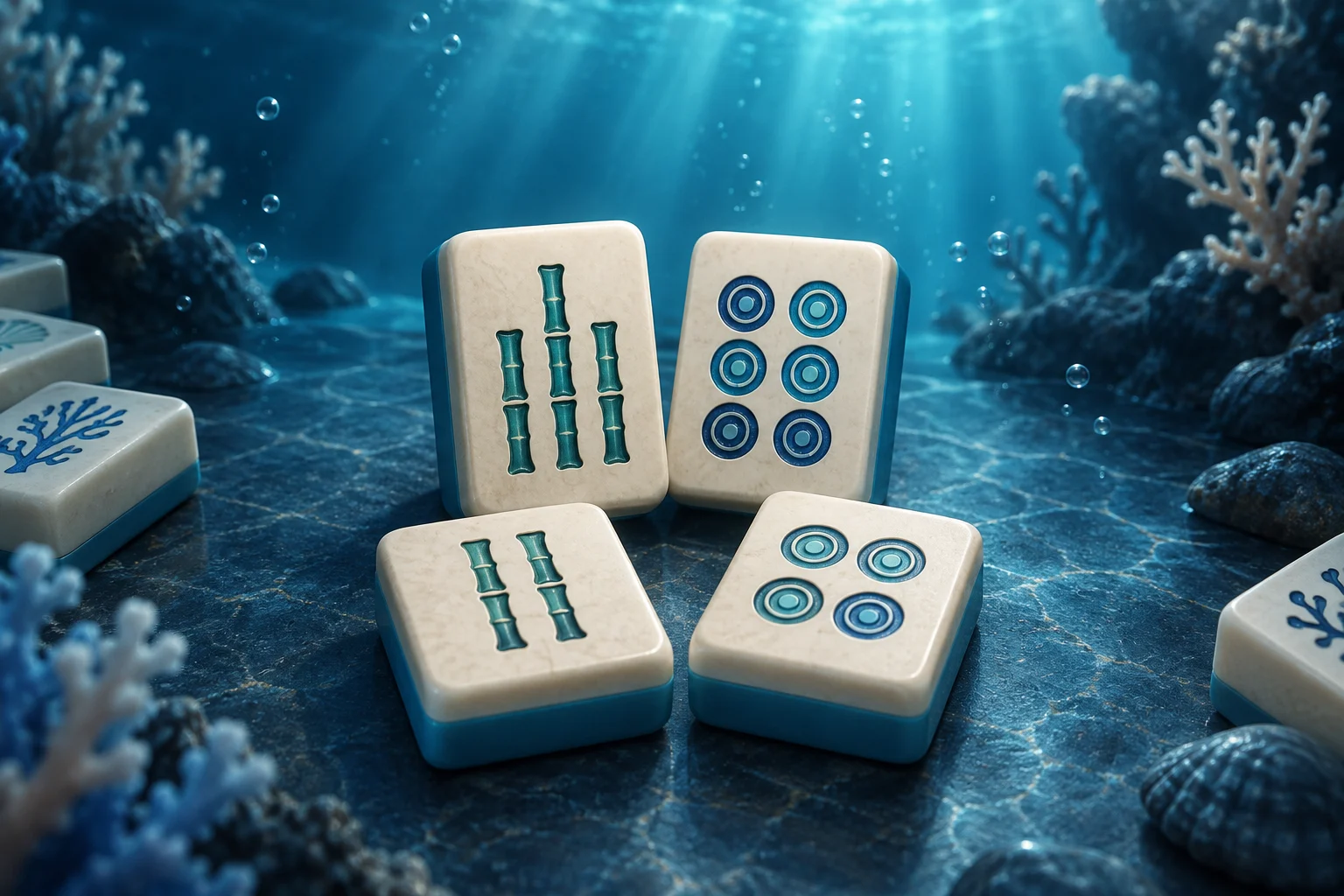
Quiet faces. Cool edges. Enough contrast to read the next pair.
Start with the edge of a tile
The first colour decision is not the ocean behind the board. It is the narrow edge beneath each ivory tile. Make that edge too bright and a stack becomes a neon staircase. Make it too dark and the layers merge together.
For our ocean mahjong direction, we are working toward pale faces above cool-blue sides, with a soft navy shadow to separate the levels. The face stays quiet so the symbol can do its job. Water and atmosphere belong around the puzzle, not across the information needed to solve it.
Mahjong solitaire still needs a readable match
Mahjong solitaire asks you to find matching tiles that are available to remove. In the common version, an available tile has no tile on top and an open left or right side. A decorative reskin should leave that relationship readable.
The design brief keeps distinct symbols, visible overlap and a clear selected state. Blue is the setting, not a reason to paint every symbol the same colour. We would check a crowded board as well as a near-empty one: an elegant isolated tile can still become confusing in a stack.
This project is a visual direction for a future FoolFish edition. The concept image is not proof that a rebuilt app, a particular level count or an offline release has passed testing.
Trade drifting leaves for rising bubbles
A leaf tumbles and drifts. A bubble lifts, expands slightly and disappears. Swapping the picture alone would keep the old motion, which might make the new bubble look like a falling coin.
The intended effect is a short upward release from the matched pair: a few translucent circles, a small highlight and a quick fade. The largest bubble should leave the tile area quickly. We want the player to notice a successful match without losing sight of the next one.
That makes the change two separate jobs: edit the particle image, then tune its direction, speed and lifetime. We will call it an in-game result only after checking both together.
A pop with a little ceramic left in it
A pure water drop sounds delicate, but it can lose the sense that two solid tiles just met. A hard clack alone keeps the old material and says nothing about the ocean.
Our sound brief combines a short, rounded bubble transient with a quieter tile-like click. The first instant should confirm the match; any watery tail should finish before the next quick pair. We will compare levels with headphones and a phone speaker, including repeated matches, rather than choosing only the nicest isolated sound.
This is the target for a sound study. It is not an audio preview of a finished build.
What belongs on the workbench
The initial work is deliberately small: a cool-blue tile treatment, an ocean background, a bubble texture and a matching-sound variation. Existing tile symbols and board structure provide a useful reference while we evaluate the palette.
After those pieces are ready, the next test is a single complete loop: open a board, select two tiles, remove the pair and read the board again. Resource editing, successful installation and reliable offline play are different milestones. We will document them separately as the project advances.
Would you spend a few minutes here?
Use the button below if ocean mahjong is the direction you would like us to prioritise. It records an interest request; it is not a download, preorder or guarantee of a release date.
You can already explore tile matching on FoolFish through Mahjong Clearer. That existing game is separate from the ocean concept shown here.
Want us to build this sooner?
Your request helps us decide which concept to prioritise. No payment, email sign-up or promised launch date.
One request per browser and concept. Stored for up to 90 days. PrivacyConcept illustrations created with AI assistance and reviewed by FoolFish Games.