
Go Fish card game: one question changes the table
Learn how to play Go Fish with a worked turn, then explore our plans for a clear, friendly Go Fish online experience at FoolFish Games. Release update — 10 October 2026: Go Fish and Fish Go Fish are now playable as single-player browser games against the computer. The planning notes, concept artwork and interest button below belong to the original preview; current rules and game links appear in the release update section.
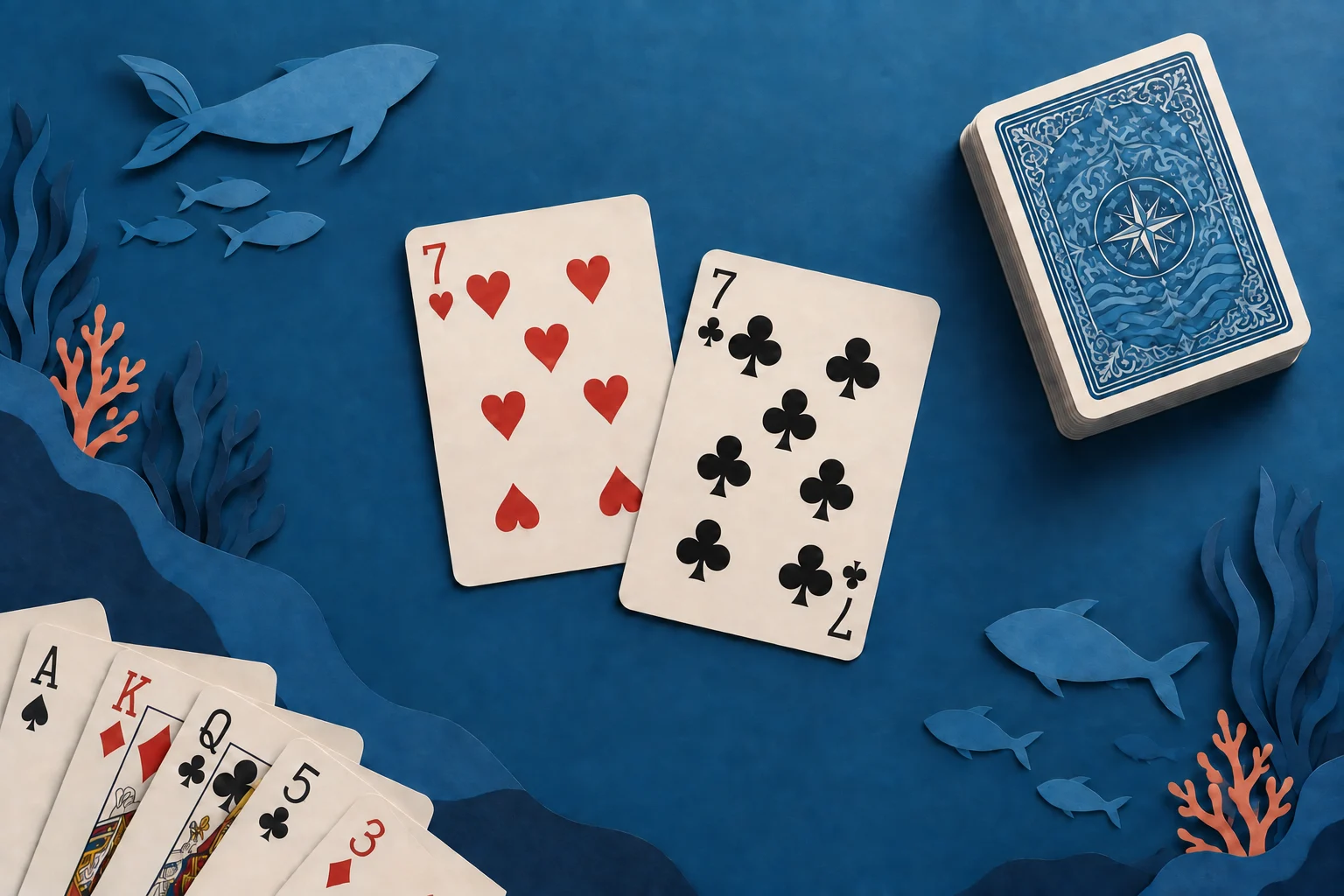
Two sevens. Two different suits.
The question is who has the others.
You have a seven. Who do you ask?
Three players are sitting around a table. Your hand contains the seven of hearts, a queen and two fours. A player across from you asked for sevens on their last turn. You have a useful clue: they held at least one seven then. Unless they have since given it away or laid down a complete set, that rank may still be in their hand.
That small act of remembering is the pleasure of Go Fish. The cards are hidden, but the conversation is public. Every request tells the rest of the table something. You are collecting sets while giving away just enough information to take another turn.
Go Fish rules: how to play with a standard deck
Go Fish has house-rule variations. For this example, use a standard 52-card deck and collect books of four cards of the same rank: all four sevens, for instance. Suits distinguish the cards but do not change the rank you ask for.
- Shuffle and deal seven cards each for two or three players, or five each for four or five. Put the remaining cards face down as the draw pile.
- On your turn, name another player and ask for a rank already in your hand: “Do you have any sevens?”
- If that player has cards of that rank, they give you all of them. You take another turn.
- If they have none, they say “Go fish.” Draw one card. In the version described here, drawing the rank you asked for gives you another turn; otherwise play passes on.
- Lay down a book whenever you collect all four cards of a rank. If your hand becomes empty and cards remain in the pile, draw a card when it is your turn to continue.
- When all 13 books are collected, the player with the most books wins. Equal totals are a tie. Agree on any house rules before dealing.
A seven, a miss, and a useful clue
Suppose you ask Maya for sevens. She hands you the seven of clubs. You now have two sevens, and you can ask again. This time you ask Leo for fours. He has none, so you draw. The card is a nine: it is not the rank you requested, and your turn ends.
Notice what changed beyond your hand. Maya and Leo both heard you ask for fours. Leo now knows you have that rank, while you know he did not have a four at the time of the request. Those clues can become outdated after later draws and exchanges. Remember the sequence, not just a permanent list of who has what.
A Go Fish card game online, built for a small screen
Our planned FoolFish version starts with a modest design question: can a new player understand a turn without opening a wall of instructions? The proposed table would keep your hand at the bottom, opponents above it and completed books off to one side.
On a phone, the rank you tap should become unmistakable before you choose an opponent. A short, visible history of requests would make a missed line of dialogue less frustrating. We are also considering a quieter mode with fewer movements between turns. These are design intentions, not features available to play today.
- A clearly selected rank, with shape and text cues rather than colour alone.
- A readable explanation after a failed request or a successful draw.
- A compact table that works in portrait without covering the hand.
Would this be your next card game?
The FoolFish Go Fish concept is not released, and we have not set a launch date. The button below records your interest so we can compare this idea with our other planned fish games. It does not make a payment, join an email list or promise an earlier release.
While the card table takes shape, you can browse the games already available on FoolFish. We will keep the difference between playable games and studio concepts visible.
Release update: Go Fish is now playable on FoolFish Games
Update checked on 10 October 2026: Go Fish and the ocean-themed Fish Go Fish are available to play in the browser. This article began as a design preview. Its planning badge, concept artwork, interest button and earlier “Not yet” answer are retained as parts of that original preview, rather than statements about the availability of these current releases.
The released Go Fish edition is single player against the computer, with Easy, Medium and Hard choices. It is not a remote multiplayer table. Its deck contains 52 cards, each side starts with seven, and the goal is to collect more four-card books than the computer. The game page contains the current controls and save instructions.
The browser rule that differs from the tabletop example
The earlier tabletop example grants another turn when a failed request is followed by drawing the requested rank. The current FoolFish browser edition uses a different variant: a failed request draws one card and then passes the turn, even when the draw matches. A successful request still lets you ask again. Keep that distinction in mind when switching from a physical deck to the online game.
For example, you hold three fours and ask for fours. The computer has none, so you draw the fourth four from the pond. The book is collected automatically, but the failed request still ends your turn. You gained a book, not another request. Clicking the pond directly also draws one card and passes; an empty hand draws one card rather than receiving a fresh seven-card hand.
Choose requests from evidence, not just your largest group
Keep a short mental record of ranks the opponent requested, ranks you handed over and books already complete. These clues have different meanings. A request tells you the opponent held that rank at that moment; a completed book tells you that rank has left play. A later draw can make a previous “no” answer outdated.
Imagine you hold three fives and have just drawn a king. Earlier, the computer requested kings, and no king book has since been collected. Asking for kings now has a concrete clue behind it. Asking for fives is closer to completing a book if the fourth five is there, but it could still be in the pond. Neither choice guarantees a win. After a successful request, reassess your new hand before asking again, then try the idea in Go Fish online.
Common questions
Is Go Fish the same as a fishing game?
No. Go Fish is a card game about asking for ranks and collecting matching sets. Fishing games usually involve catching fish.
Can I play this FoolFish Go Fish game now?
Not yet. This article explains the card game and presents our planned version. The concept artwork is not a released-game screenshot. Release update — 10 October 2026: Go Fish and Fish Go Fish are now playable against the computer. The preceding answer and concept artwork refer to this article's original preview, not the current releases.
Which FoolFish Go Fish releases are available after the original preview?
As checked on 10 October 2026, Go Fish and Fish Go Fish are available on their game pages. Both are single-player editions against the computer. The older planning statements in this article describe its original preview.
What deck of cards do I need to try the tabletop example?
Use a standard 52-card deck with 13 ranks and four suits, leaving out jokers. The example collects four-card books. Agree on house rules such as whether a matching draw gives another turn; the current FoolFish browser edition always passes after a failed request.
Want us to build this sooner?
Your request helps us decide which concept to prioritise. No payment, email sign-up or promised launch date.
One request per browser and concept. Stored for up to 90 days. PrivacyConcept illustrations created with AI assistance and reviewed by FoolFish Games.