
How to play Sudoku: rules, notes and your first deductions
To play Sudoku, fill the empty cells of a 9×9 grid so that every row, column and 3×3 box contains the numbers 1 through 9 exactly once. You do not add the numbers together. You use the fixed clues to eliminate impossible placements until only one choice remains.
Check three groups for every cell
A row runs across the board, a column runs down it, and the heavier borders divide the grid into nine boxes. Each cell belongs to one of each. A digit must fit all three groups at the same time. The starting numbers are fixed; they are clues, not entries you can erase.
For a first puzzle, scan rows or boxes that already contain many digits. Write down what is missing, then check where those missing digits could fit. A nearly complete group gives you fewer possibilities to compare.
A simple Sudoku example: a row missing 2 and 7
Imagine a valid row with just two empty cells and missing digits 2 and 7. One of those cells has a 7 elsewhere in its column. It cannot contain another 7, so it must contain 2. The remaining empty cell in that row must then be 7. Check its column and box as well to confirm that your earlier entries are consistent.
This is elimination, not a guess. If you find that neither number fits, revisit earlier entries instead of forcing a digit into the row. A contradiction usually means that some assumption needs checking.
How to use Sudoku notes without confusing them with answers
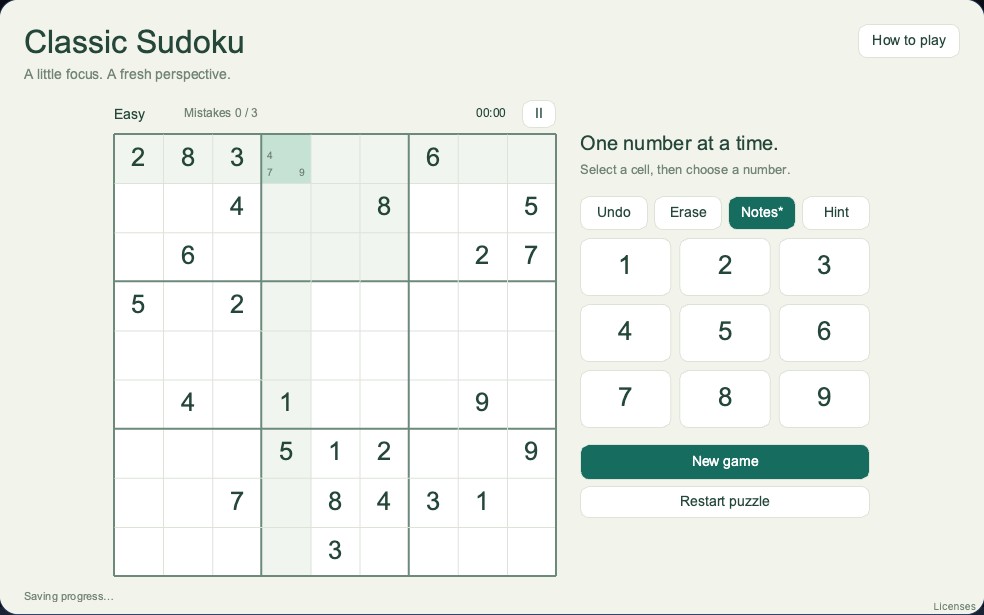
The small 4, 7 and 9 in the screenshot illustrate candidate marks, not a completed cell or a guaranteed set of correct possibilities. Notes record your reasoning; adding a mark does not make it true. You can toggle a note off when it is ruled out.
- Select an empty cell and turn Notes on. In Classic Sudoku, N toggles this mode.
- Add only numbers not already ruled out by that cell’s row, column or box.
- After confirming another entry, review the affected candidates. Correct entries in this game remove their digit from peer-cell notes automatically.
- When a cell has one remaining possibility, switch Notes off before entering the confirmed digit.
Look for a single candidate or a single place
A single candidate means one cell can hold only one number after you check its row, column and box. A single place means a particular missing digit has only one possible location within a row, column or box. In the second case, that cell may still have other notes written in it, but the group forces this digit to go there.
Try one scan for cells with few candidates, then a second scan for where a chosen missing digit could go. These are different questions. Alternating between them is often more productive than repeatedly staring at the same square.
Understand this game’s hints and mistake counter
Classic Sudoku checks entered digits against its stored solution. An incorrect digit can count as a mistake even when you do not immediately see a duplicate nearby. Standard mode ends at three mistakes. Select Practice mode before starting if you want to keep working without that limit.
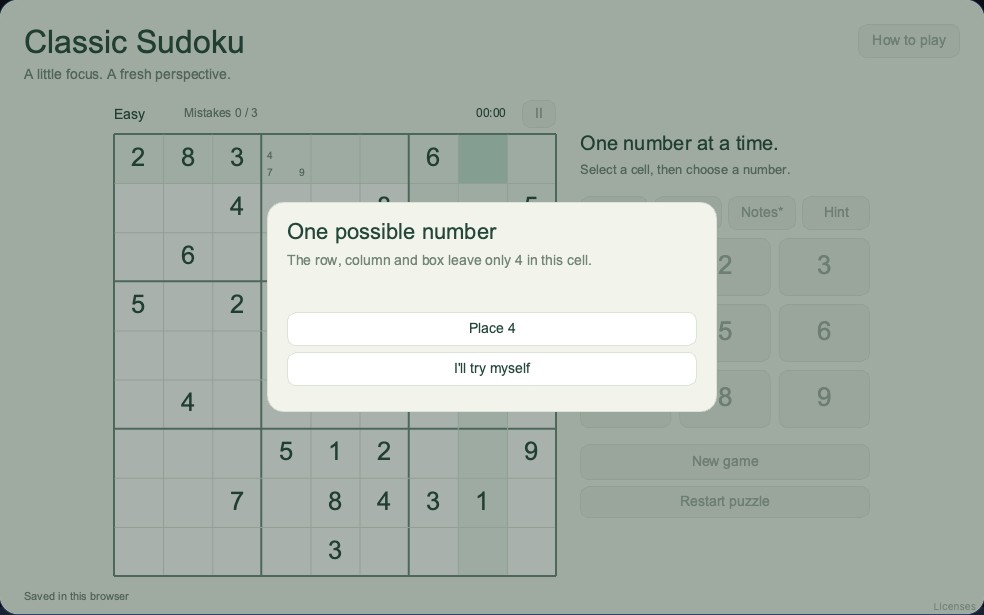
Hints first look for a wrong entry to clear, then a forced number or a unique position. When those simple deductions are unavailable, a hint can offer to reveal an answer. Reading the explanation does not increase the hint count; applying its action does. Undo changes entries and notes but does not refund mistakes or hints.
A practical routine for your first puzzle
The current approved Classic Sudoku release is for desktop. These techniques introduce the rules and basic deductions; they do not replace every advanced technique you might need on a harder puzzle.
- Start with Easy and use Practice if you want time to learn from incorrect entries. The published game contains 400 puzzles across Easy, Medium, Hard and Expert.
- Make one justified entry, then rescan its row, column and box before moving elsewhere.
- Use Backspace or Delete to erase; Ctrl/Cmd+Z undoes a move while the puzzle remains active.
- Pause when you need a break. Saved progress belongs to the same browser; website sign-in does not imply that this puzzle transfers between devices.
Common questions
What are the basic Sudoku rules?
Fill the grid so that each row, column and 3×3 box contains each digit from 1 to 9 exactly once. Do not change the starting clues.
Should I guess when I have two candidates?
Keep them as notes while looking for another forced entry. A two-candidate cell is not yet a reason to choose one at random.
Why did a move count as a mistake without a visible repeat?
Classic Sudoku checks the entry against the puzzle’s solution, not just nearby duplicates. Use notes for uncertain possibilities.