
Mancala rules and strategy: count your last stone
The fullest pit is not always the best pit. In Kalah Mancala, your final stone can earn another move, capture the opposite pile or end the whole game. This guide uses the FoolFish board to show exactly how those three outcomes work.
This board uses Kalah: twelve pits, forty-eight stones
Mancala names a family of sowing games. The Mancala game on FoolFish uses Kalah: six small pits per player, four stones in each pit at the start, and a large store at each end. Player 1 begins on the lower row with the store on the right. Player 2 uses the upper row and the store on the left.
Choose a nonempty pit on your side, pick up all its stones, then drop one into each following space around the board. Along the lower row you travel right; along the upper row you travel left. Include your own store and skip the other player’s store. Keep going around the board if the handful is large enough.
Count from the pit after the one you picked. The emptied starting pit is not your first drop. This small distinction matters when you are trying to finish exactly in a store or an empty pit.
Your first extra turn: four stones, four landings
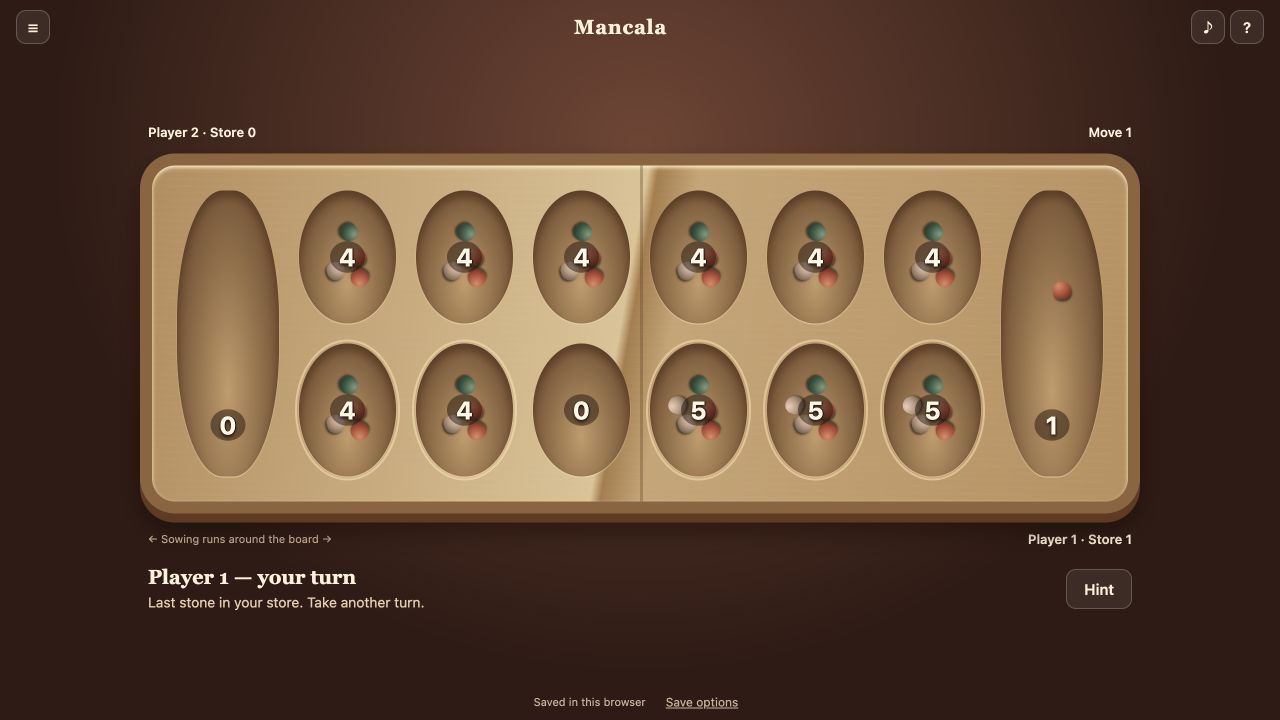
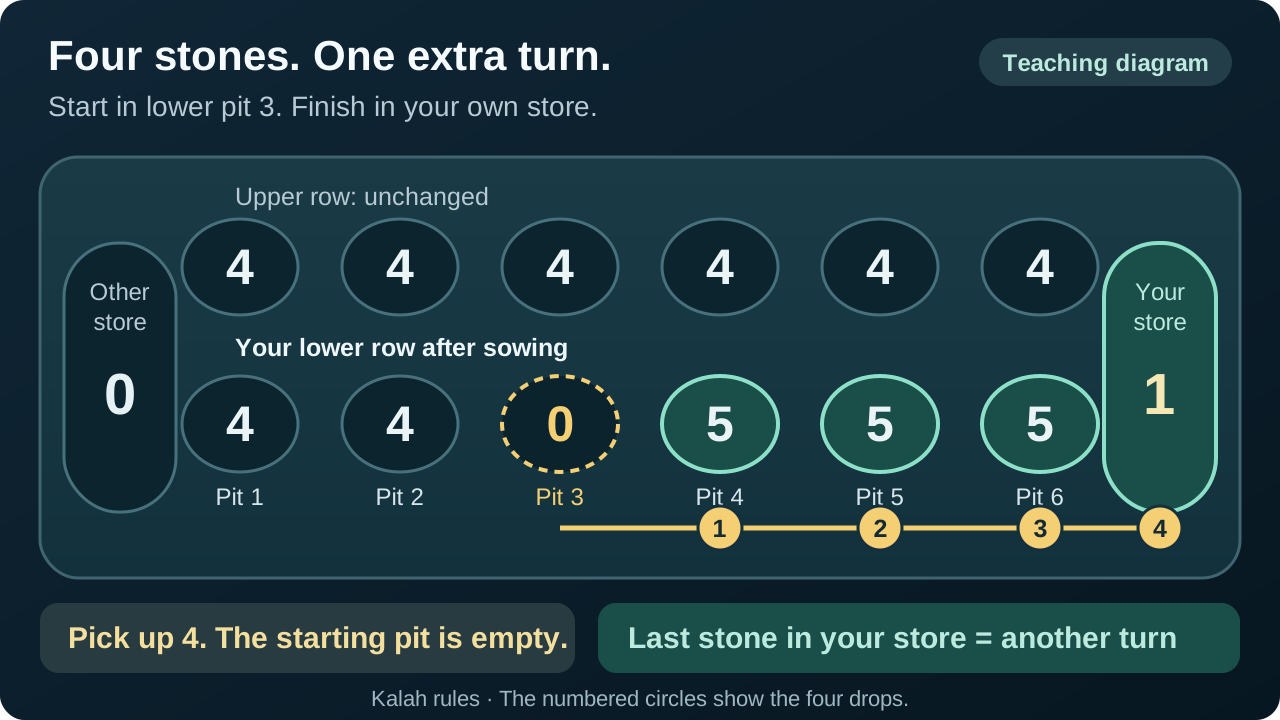
On a fresh board, choose the third lower pit from the left. It contains four stones. The first lands in the fourth pit, the second in the fifth, the third in the sixth and the fourth in your right-hand store. Because the last stone lands in your own store, it is still your turn.
After the animation, the lower row reads 4, 4, 0, 5, 5, 5 from left to right, and your store contains 1. The upper row has not changed. You may now choose any nonempty pit on your side; the extra turn is not restricted to the pit you just emptied.
This is a reproducible starting-board example, not a guaranteed winning opening. Its useful lesson is to count the final landing before you click, then count again from the new board. The extra move changes the contents of several pits, so the old counts no longer describe the next decision.
A short count beats choosing the biggest pile
For a lower-row pit, count the spaces from that pit to your right-hand store. The pit nearest the store needs one stone to finish there; the next needs two, and so on. On the initial board, the third pit is four spaces from the store, matching its four stones.
That shortcut works for a handful that reaches the store directly. A large pile can continue onto your opponent’s row and around again. Trace the whole route and skip the opponent’s store each time you pass it. A pile larger than six is not automatically a bonus move.
There are two separate questions: where does the final stone land, and what do the intermediate drops change? Sowing into an opponent’s pit may give them an extra-turn count or enlarge a pile across from one of your empty pits. The same move can improve your store and alter a future capture.
A three-turn example that captures seven stones
A capture needs both conditions: your last stone must land in a pit that was empty on your own side, and the directly opposite pit must contain stones. Move the opposite pile and your final stone into your store. An empty opposite pit gives no capture, and landing on the opponent’s empty side does not capture either.
Try this legal teaching line in Play with a friend, starting from a new board. The choices show the mechanism; they are not a promise that the computer will choose this reply.
- Player 1 chooses the fifth lower pit from the left. Its four stones finish on the upper row. The lower fifth pit becomes empty, Player 1’s store becomes 1, and the upper pit second from the right now holds 5.
- Player 2 chooses the upper pit nearest the right edge. It now contains 5 stones, which sow left along the upper row. The pit second from the right increases from 5 to 6. Neither of these turns earns a bonus.
- Player 1 chooses the leftmost lower pit, which still holds 4. The fourth and final drop lands in that empty lower fifth pit, directly opposite the upper pile of 6.
- Capture the 6 opposite stones plus the stone you just dropped: 7 move to Player 1’s store. Its total rises from 1 to 8, and both the landing pit and the opposite pit become empty.
An empty pit is an opportunity for either side
Before opening a pit, inspect the pile across from it. An empty pit on your side can become a capture target if a later move finishes there, but it can also stop being empty when either player sows a stone into it. Treat a capture plan as a count to update, not a fixed promise.
Also look at your opponent’s empty pits. If your move enlarges a pile opposite one of those pits, check whether the opponent can finish a sow there on the next turn. A move that adds one stone to your store may expose several stones to a reply.
An extra turn is valuable because you choose again before that reply. After earning one, check captures and the ending condition before reflexively selecting the fullest pit. Hint marks a suggested pit without playing it; you can count its route yourself before committing.
A 20–18 lead can still become a 21–27 loss
The game ends as soon as either side’s six small pits are empty. All stones still sitting in the other side’s pits go into that player’s store. Compare the stores after this final sweep, not before it. More stones wins; 24–24 is a draw.
Consider a small endgame example. Your store has 20 and your opponent’s has 18. Your only remaining pit is the one next to your store, with 3 stones. Your opponent has 7 stones spread across their row. Sowing your 3 gives one to your store and drops the other two onto the opponent’s side.
Your row is now empty, so the game ends. Your store finishes on 21. The opponent collects their original 7 pit stones plus the 2 you just added, taking their store to 27. The visible 20–18 lead was not enough. When a move may empty a side, count the final drops and the sweep together.
This is a rule-checked teaching position with all forty-eight stones accounted for. In your own endgame, use the actual pit counts; moving your last handful does not always send every stone into your store.
Practice a pattern, then change the opponent
Play with a friend is useful for reproducing a counting example because two people can take turns on the same device. It does not open a remote room. Click or tap a pit, or use Tab and Enter to activate a focused pit.
Play computer offers Easy, Medium and Hard. Easy chooses a random legal pit. Medium looks for an extra turn, then a capture. Hard searches ahead. A counting habit still matters at every level: a suggested move is easier to understand when you can follow its final landing.
Learn to play walks through seven short lessons, including skipping the other store, captures and the final sweep. This Mancala edition has Hint but no Undo control. Use a fresh local board to repeat an example, and remember that starting a new board replaces your current match.
Starting a new mode gives the lower player the first move. After a completed match, Play again lets the previous loser start; after a draw, the starting player alternates. Check the turn label on a rematch instead of assuming the lower row always moves first.
Return to the board without losing the count
Continue game uses the saved match. Guest progress stays in the current browser; sign in on FoolFish before opening the game for account checkpoints. Watch the footer for Saved in this browser, Saved to your account, a conflict or a failure. Save options lets you inspect the situation and choose between conflicting boards rather than silently combining them.
If you switch away during sowing, the saved move records its resulting board. When you return, recount that board rather than expecting to resume halfway through dropping the same handful. The animation illustrates a move; the resulting pit totals determine the next turn.
For another game about ordering moves, read mahjong solitaire strategy: there, an apparently harmless pair can change which tiles are available next. The Backgammon beginner guide adds dice, blocked landings and return hits to a board race.
You can also keep the Kalah rules and change the setting in Fish Mancala, or browse free board games for your next match.
Common questions
Which Mancala variant is this?
FoolFish uses Kalah with six pits per player, four starting stones in each pit, stores, extra turns, opposite-pit captures and a final sweep.
Do I skip both stores when sowing?
No. Include your own store and skip your opponent’s. Continue around the board if you still have stones to place.
Does an empty opposite pit still give me a capture?
No. Your final stone must land in an empty pit on your own side and the opposite pit must contain stones. The captured total includes your final stone.
Does my last move earn an extra turn if it ends the game?
No. When either row becomes empty, the final sweep and scoring end the game. A store landing does not continue a finished match.
Can I undo a Mancala move?
This release has no Undo control. Hint suggests a pit before you move. To repeat a worked example, start a new same-device game.