
Backgammon for beginners: why your move is blocked
Your dice show a move, but the point will not light up. In backgammon, the route, the bar and the obligation to use your roll can all limit a move. This beginner guide explains what to check, with a 3–1 opening and two small rule examples from FoolFish Backgammon.
Read the route before reading the roll
Each player has fifteen checkers. Bring all of yours into your six-point home board, then remove them before your opponent removes theirs. In the unflipped view, Ivory travels from point 24 toward point 1; Red travels from point 1 toward point 24. The numbers on the board keep those routes clear after you use Flip.
A point with two or more opposing checkers is closed. An empty point, a point occupied by your own checkers, or a point with only one opponent is available as a landing. You may pass closed points along a die’s distance; it is the landing for each individual die that must be available.
Open Backgammon, choose Play a friend to examine both sides on one device, and use the point numbers while you learn. The first player is chosen at random in this edition, so do not expect Ivory to begin every new game.
A 3–1 opening that builds a safe point
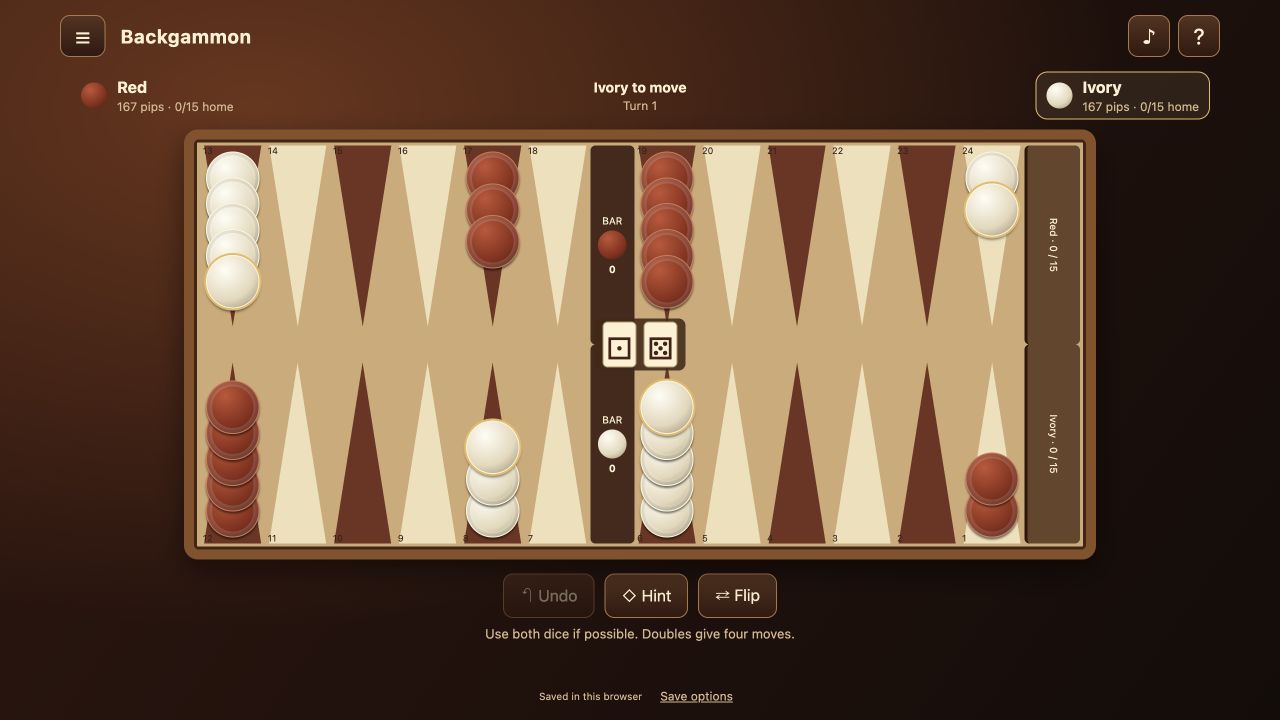
Suppose Ivory gets 3 and 1 on the standard starting board. One useful way to spend them is to bring a checker from point 8 to point 5 with the 3, then a checker from point 6 to point 5 with the 1. You have created two Ivory checkers on point 5. Red cannot land there, and neither move leaves a new single checker behind on point 8 or 6.
The pip count falls from 167 to 163: you have advanced four points in total. That is the same distance many other legal 3–1 choices travel. The difference is the position you leave behind. Look at both the race distance and the points you make, rather than judging a turn only by its largest number.
This is a rule-checked opening example, not a guarantee of the best move in every position. Later in a game, a hit, a bar entry or the state of the race can make the same dice serve a different purpose.
- When Ivory’s opening roll is 3 and 1, check the starting board before making the first move.
- Select point 8, then its highlighted point 5 destination for the 3.
- Select point 6 and move another checker to point 5 with the 1.
- Check that point 5 now holds a pair before ending the turn.
Why two dice are not one long jump
A roll of 3 and 1 gives a three-point move and a one-point move. You can spend them on different checkers, or use both on one checker as two separate moves. If a checker can reach its final destination only by passing through an illegal intermediate landing, you cannot treat the dice as a single four-point jump.
The order may matter. Check the three-point landing and the one-point landing separately. A route that works when you use 1 first may fail when you use 3 first. Tap a die to filter its legal moves; tap it again to return to all available choices.
You must use both dice when a legal sequence allows it. If only one die can be used, use the higher one when it is legal. Doubles supply four moves of that value, and you must use as many as possible. The highlights enforce those obligations, so an apparently open destination can disappear if that first move would unnecessarily waste part of the roll.
On the bar: a 2 is blocked, a 5 hits back
A single opposing checker is a blot. Landing on it sends it to the bar. If you have a checker on the bar, you must re-enter it before moving any checker already on the board. Ivory enters through points 24 to 19; Red enters through points 1 to 6.
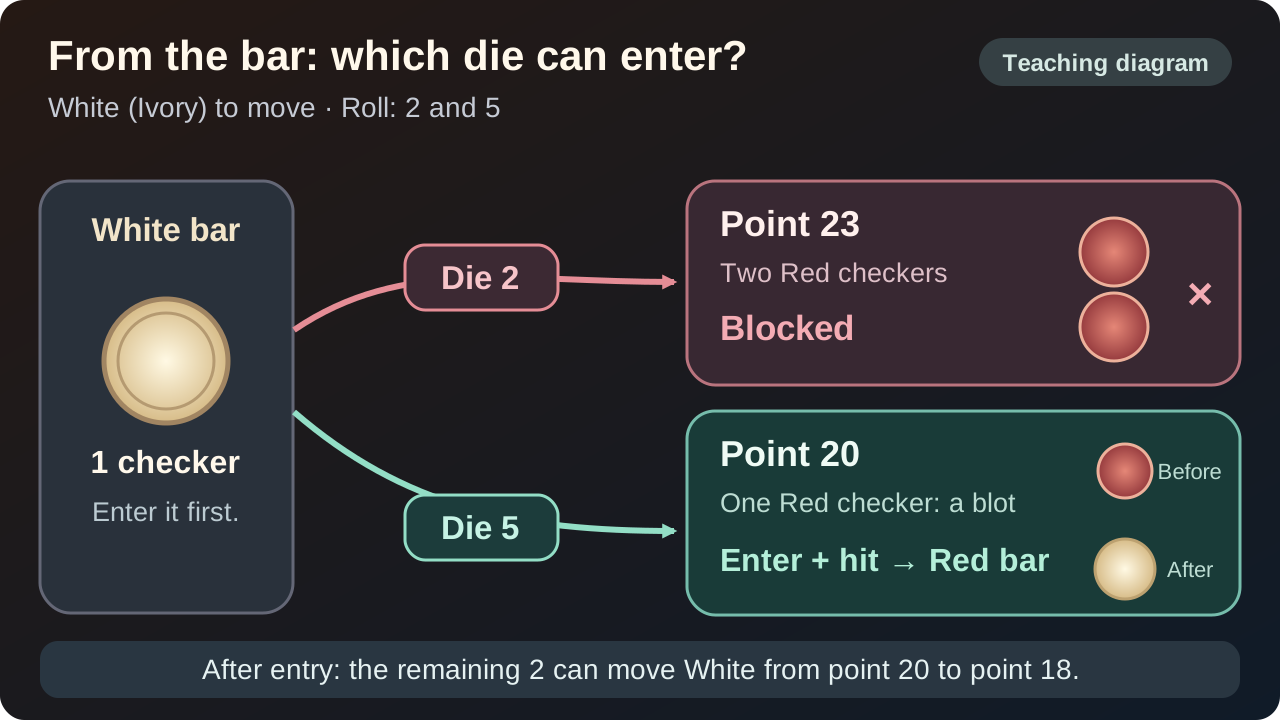
Consider the teaching position below: Ivory has one checker on the bar and fourteen on point 6. Red has two checkers on point 23, one on point 20 and twelve on point 19. With a roll of 2 and 5, the 2 would enter Ivory at point 23, which is closed. The 5 enters at point 20, where the lone Red checker is hit and moves to Red’s bar.
The 2 is not automatically lost. After entering, Ivory can use it to move that checker from point 20 to the open point 18, or make another legal two-point move. Recheck the remaining die after every entry. If you still have another checker on the bar, that checker retains priority.
If both entry points are closed and no entry is possible, finish the turn. A blocked bar is a rule consequence, not a reason to keep trying a different checker.
Bearing off: when a larger die is allowed
You can start bearing off only when all your remaining checkers are in your own six-point home board and none is on the bar. An exact die removes a checker from its corresponding point. A larger die can remove a checker only from your furthest occupied point.
For Ivory, imagine twelve checkers are already off and the last three are on points 6, 3 and 1. A 4 cannot remove the checker on point 3 while point 6 is still occupied. Move the checker from 6 to 2 instead. With the remaining checkers now on 3, 2 and 1, a later 4 can remove the checker on 3 because that is the furthest occupied point.
If an opponent hits you during this phase, the checker on the bar must enter and return home before bearing off resumes. Read the position again after a hit; reaching your home board once does not permanently unlock the tray.
Three questions to ask before ending your turn
Which checker becomes exposed? A move that hits Red can leave your own blot available for a return hit. Count the nearby opposing checkers and inspect their route before assuming the hit is a free advantage.
Which point becomes harder to enter? Two checkers together deny a landing. Several consecutive closed points can slow an opponent, especially one on the bar. Moving a checker away from a two-checker point may trade that protection for racing distance.
Are we still in contact? Pip counts compare the distance left to travel, but they do not show all the risks of a board where opponents can still hit each other. When the checkers have passed and no return hit is possible, efficient movement and bearing off become more central.
If you enjoy deciding what a move exposes, the mahjong solitaire strategy guide explores that question in a pair-removal puzzle. For a race where every landing can be counted without dice, try the Mancala rules and strategy guide.
Use Hint and Undo to study the same roll
Hint selects a suggested checker and die; you still make the move. Compare the suggestion with your own plan and ask which point or blot it changes. Undo reverses your moves within the current turn without giving you new dice. End turn commits that turn, so use Undo before you finish if you want to examine another legal order.
Play the computer is solo play. Play a friend shares the current device, with Flip to rotate the view when you pass it over. This release is a single-game race with no remote rooms, doubling cube or wagering.
Continue game restores a saved board and unfinished dice. Guest progress is stored in this browser; sign in on FoolFish before opening the game to use account checkpoints. Check the save message rather than assuming every device has synced. Save options exposes a failure or a conflict and lets you choose which board to keep. Starting another game replaces the current one.
Use this guide alongside free board games when choosing your next match. Prefer a quieter visual theme? Fish Backgammon applies the same race, hit and bar-entry rules to an ocean board.
Common questions
Why can I not move another checker while one is on the bar?
Bar entry has priority. Re-enter every checker on your bar through an available opponent-home-board point before moving a checker already on the board.
Can I use both dice on the same checker?
Yes, as two separate moves. Each intermediate landing must be legal, and the sequence must satisfy the requirement to use as much of the roll as possible.
Why can a larger die not remove my nearest checker?
An oversized die may bear off from your furthest occupied point, not any shorter point while a checker remains further back.
Does Undo roll new dice?
No. Undo changes moves within the current turn while preserving the roll. It is not available to reverse a turn you have already ended.
Can a friend join from another device?
No. Friends mode is for two people taking turns on one device. This Backgammon release has no online matchmaking.