
Checkers rules and strategy: follow the whole jump
In Checkers, the move you want may disappear because a different piece can jump. The first rule to check is whether a capture exists anywhere on your side of the board. This guide explains the FoolFish edition with a small two-route position, then turns the rules into a repeatable way to think before moving.
First, know which checkers rules you are playing
This Checkers game uses an 8×8 board with twelve pieces per side. Black moves first. Ordinary pieces move and capture diagonally forward; kings can move and capture in both directions. A move uses only the dark squares.
If any piece can capture, you must make a capture. After starting a jump chain, continue with that same piece until no further legal jump exists. You may choose between complete legal routes; the route taking the most pieces is not mandatory. Reaching the far row crowns the piece and ends that turn.
Those details distinguish this edition from other games also called checkers or draughts. Do not bring across flying kings, backward captures by ordinary pieces, or a compulsory longest-capture rule. Fish Checkers changes the coral-and-pearl presentation while keeping these same rules.
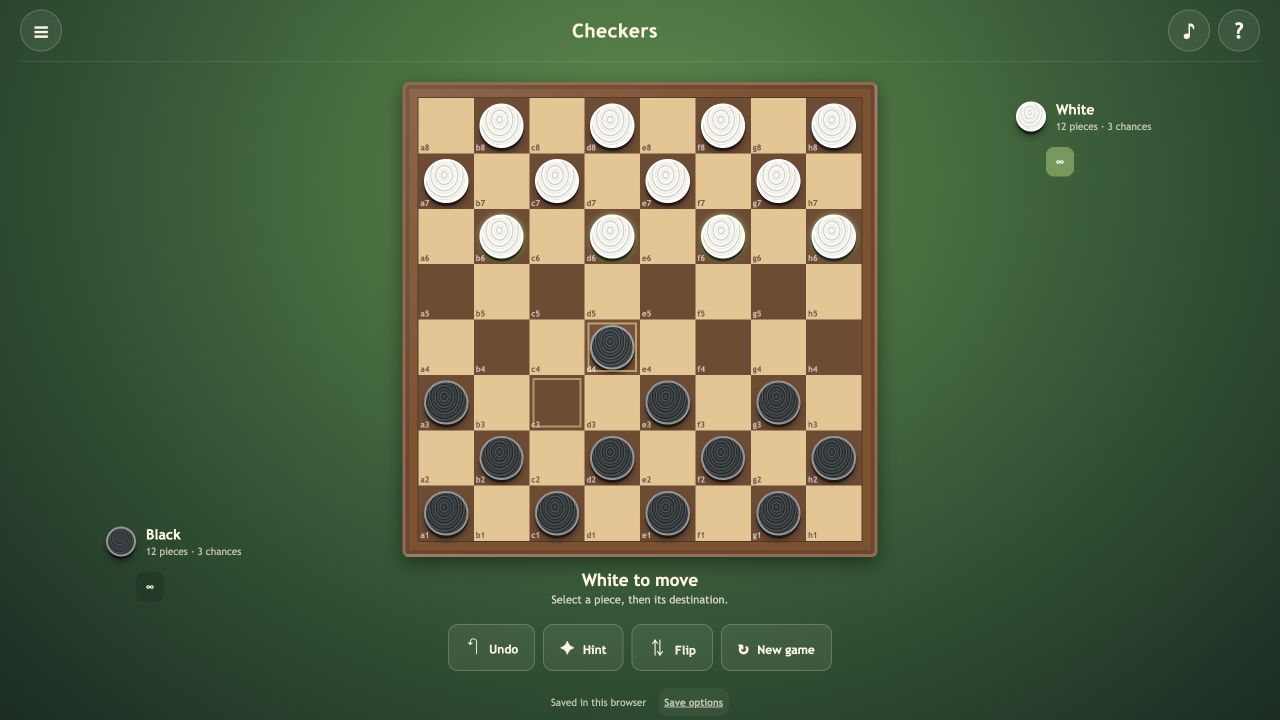
Choose a game where you can study the reply
Play the computer offers Easy, Casual, Medium, Hard and Expert. Start untimed on a lower level while you learn to trace jumps. Play a friend lets two people use one phone, tablet or computer; it does not create a match across the internet.
Click or tap a piece and a highlighted destination. Keyboard arrows move the board focus, and Enter or Space selects a square. Flip changes the view when passing a shared device; it does not reverse a piece’s legal forward direction. Square names in the examples below run a to h from Black’s starting-side view, with rank 1 at the bottom.
- Before selecting a piece, look for any available capture on your side.
- Select the capturing piece and inspect each complete route.
- After a jump, keep using that piece if another jump is available.
- Once the turn ends, inspect the opponent’s compulsory replies.
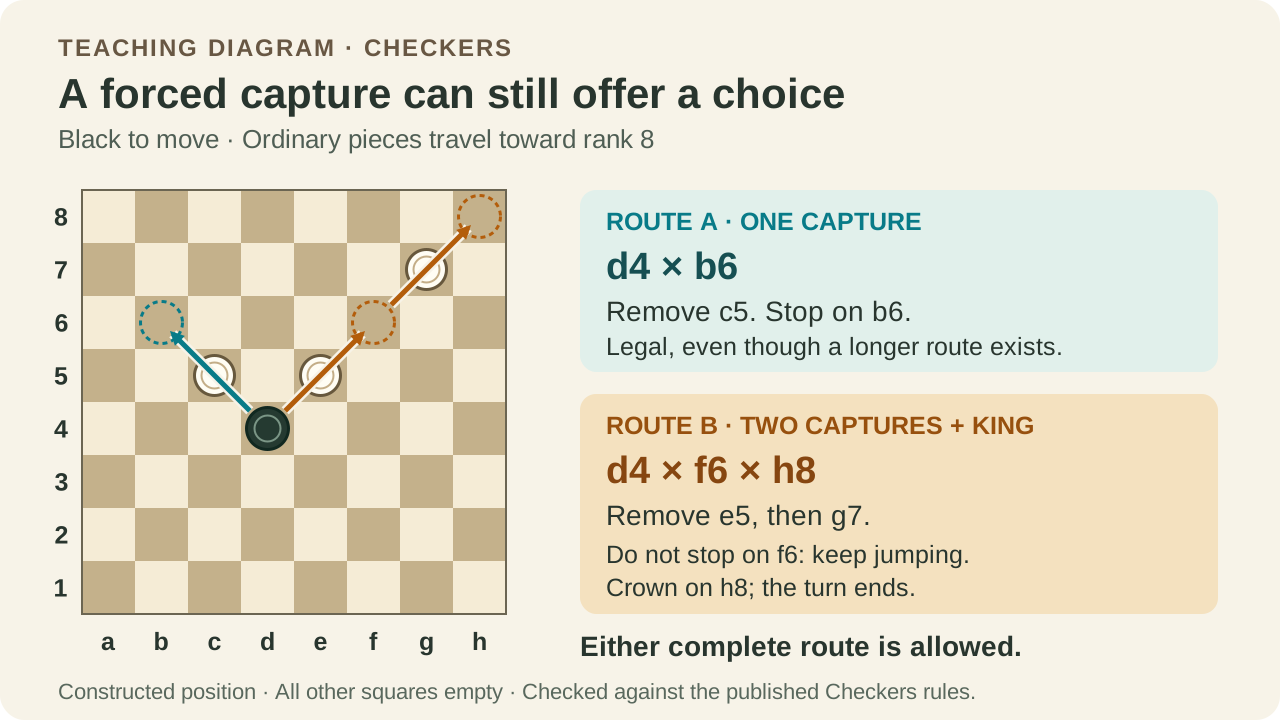
One black piece, two legal routes
Use this constructed teaching position: a black ordinary piece is on d4; white pieces are on c5, e5 and g7; all other squares are empty. Black moves toward rank 8. Square b6 is empty beyond c5, and f6 is empty beyond e5, so the black piece has two possible first jumps.
The left route is d4 × b6. It removes the white piece on c5 and then ends because there is no further jump from b6. The right route is d4 × f6 × h8. It first removes e5, then jumps the white piece on g7 and reaches h8. Reaching rank 8 crowns the black piece.
Both complete routes are allowed by this edition. The single jump remains legal even though a two-capture route exists. If you choose the right route, however, you cannot stop on f6: its next jump is available, so the same piece must continue to h8. We checked both routes with the rules code from the current released build. This is a constructed example, not a position claimed to have appeared in a recorded match.
Evaluate the landing square, not only the first victim
In the teaching position, the longer route removes more pieces and also makes a king. That makes its consequences easy to see. A real board can include other defenders and reply jumps, so count the captures and then inspect the landing square before deciding. More captured pieces do not by themselves prove that a route is safe or wins the game.
For each candidate route, read every landing in order. Ask which opposing pieces disappear, which diagonals open, and whether your final piece can be captured on the reply. A piece offered as bait may force you along a chain that ends somewhere less useful. You cannot solve that question by considering only the first adjacent opponent.
This is a useful comparison with Chess: chess allows many quiet alternatives, while an available checkers capture removes those quiet choices. In both games the final position matters; in Checkers you must also respect the whole forced route.
- Can the final landing square be reached by an opposing jump?
- Does the route open a different capture for the opponent?
- Will the piece become a king, and does promotion stop this turn?
- Which pieces still support one another after the captured pieces are removed?
Crowning stops the turn, even if a new king could jump back
Here is a second constructed position: Black has an ordinary piece on d6, while White has pieces on e7 and g7. Everything else is empty. Black jumps d6 × f8 over e7. The piece reaches the far row, becomes a king, and the turn ends immediately.
The white piece on g7 is still present. A king on f8 could normally jump backward over g7 to h6, but the new king does not take that second jump in the same turn. White must have a turn first. This crowning rule was checked against the published rules engine and is important when reading a chain near the edge.
Once a king begins a later turn, it may move one diagonal square forward or backward, or jump an adjacent opponent into the empty square immediately beyond. It does not slide along a whole empty diagonal. A distant opponent with several empty squares between it and your king is not an immediate capture.
Keep pieces working together without blocking yourself
A neighboring piece can protect a landing square by creating a return jump if the opponent captures. Before leaving a supported group, inspect the diagonal that becomes exposed. The aim is not to keep every piece crowded together; a cluster with no safe exits can also become a trap.
Pieces near the back row make an opponent’s route to promotion harder, but keeping all of them there indefinitely leaves fewer active choices. Move with a purpose: improve a diagonal, support another piece, or create a route to a king. Avoid treating a single opening pattern as a guaranteed strategy for every opponent.
Mobility matters as well as piece count. You win if the opponent has no legal move, even when some pieces remain. Before making a quiet step, check both of its possible diagonal replies and any jump it gives your opponent. The habit of asking what a move opens also appears in our mahjong strategy guide, although that puzzle uses pairs rather than opposing armies.
How this edition ends a game
A player wins by capturing all opposing pieces or leaving the opposing side with no legal move. Unlike chess stalemate, a blocked Checkers player loses. In same-device play, the menu also lets both players agree to a draw.
This edition automatically draws after 30 consecutive moves without a capture. The counter advances on each player’s completed move, so it means 30 turns in total, not 30 moves by each side. A capture resets it. Keep that local rule in mind instead of assuming every draughts website uses the same draw condition.
If a game ends before the piece count reaches zero, read the stated result reason. A blocked board, the no-capture draw limit, a resignation and a timed loss are different outcomes. That reason gives you a specific decision to review.
Use the clock and tools to learn one decision
Optional timed play gives 45 seconds per turn. If time expires, the game chooses a legal move automatically. Three missed turns lose the game. Menus and hidden tabs pause the timer. Start without the clock if tracing a multi-jump still takes most of your attention.
Hint suggests a route; inspect its destination and the opponent’s reply before copying it. Once you have begun a multi-jump, finish that chain rather than trying to switch to another piece. Undo against the computer takes back the turn so you can compare a different choice; in local play it takes back one completed move.
A simple practice exercise is to name the final square before making a capture. After the opponent responds, check whether you overlooked an available return jump. That gives you something more useful to correct than a general feeling that you should have played faster.
Keep the exact board, then choose your next practice task
Continue game restores a saved board. Guest progress belongs to the same browser. Sign in on FoolFish before opening the game for supported account checkpoints. Save options shows conflicts when another device holds a different position; choose this board or the cloud board deliberately rather than silently replacing a game you wanted to keep.
For your next match, focus on one rule: noticing a compulsory capture before selecting a quiet move, tracing a complete double jump, or predicting where a new king must stop. Fish Checkers is useful if you prefer ocean artwork without learning another ruleset. Browse board games when you want a different planning problem.
Common questions
Do I have to jump when a capture is available?
Yes. If any of your pieces can capture, you must choose a legal capture instead of an ordinary step.
Must I choose the route that captures the most pieces?
No. In this edition any complete legal route is allowed. Once you choose a route, you must keep jumping with that piece while another jump is available, unless promotion ends the turn.
Can an ordinary piece capture backward?
No. Ordinary pieces move and capture forward. A crowned king can move and jump forward or backward.
Can a newly crowned king keep jumping immediately?
No. Reaching the far row crowns the piece and ends that turn. It may use its backward movement on a later turn.
Is it a draw when I still have pieces but cannot move?
No. A player with no legal move loses in this edition. The automatic draw condition is 30 consecutive completed moves without a capture.
What happens when the 45-second turn timer expires?
The game makes a legal move automatically. Three missed turns lose the game. Untimed play is available for practice.