
Your first chess game: moves, castling and keeping the king safe
The first useful chess habit is not remembering a long opening. It is checking what your opponent attacks before you move. This guide starts with the pieces, follows a short legal opening into castling, and shows how to use the practice tools in FoolFish Chess without confusing a suggested move with a guaranteed plan.
Start with an untimed board
Open Chess and choose Play computer for solo practice or Play a friend for two people taking turns on the same device. For a first game, set Time per side to Unlimited and keep Show legal moves enabled. White moves first. The computer offers 21 difficulty settings; those numbers are levels, not Elo ratings.
Choose a lower computer level while you learn to notice attacks. Same-device play is useful for following the fixed opening below because you control both sides; it does not connect two remote opponents. If you prefer underwater pieces, Fish Chess keeps the same legal moves and winning objective.
- Choose your mode and, against the computer, your color and level.
- Start an untimed game with legal-move highlights on.
- Select a piece, inspect its destinations, then select the square you intend to use.
Read a square before choosing a piece
From White’s side, files run a through h from left to right and ranks run 1 through 8 from bottom to top. A square name combines the file and rank: e4 is on the e-file and fourth rank. Flipping the view changes where a square appears on the screen, not its name.
A move must follow the selected piece’s rule, fit around any blockers, and leave your own king safe. Legal-move highlights answer whether a move is permitted. They do not promise that the destination is safe from the opponent’s next capture.
- A rook moves any clear distance along a rank or file; a bishop moves along a clear diagonal.
- A queen combines rook and bishop movement. None of these pieces jumps over a blocker.
- A knight moves two squares in one direction and one across. It can jump over pieces.
- A king moves one square to a square that is not under attack.
- A pawn moves forward into empty space and captures one square diagonally forward. From its starting square it may advance two if both squares are clear.
A short opening: make room before you castle
Use Play a friend to reproduce this teaching line: 1. e4 e5 2. Nf3 Nc6 3. Bc4 Bc5. Move White’s e-pawn from e2 to e4, Black’s e-pawn from e7 to e5, White’s knight from g1 to f3, Black’s knight from b8 to c6, and then the bishops from f1 to c4 and f8 to c5.
Each White move has a visible job. The pawn claims central space and opens a diagonal for the bishop. The knight develops toward the center and attacks e5. The bishop leaves f1, while the knight has already left g1. White’s king and h1 rook now have a clear route between them. These are legal teaching moves, not a claim that Black must respond this way or that the line wins every game.
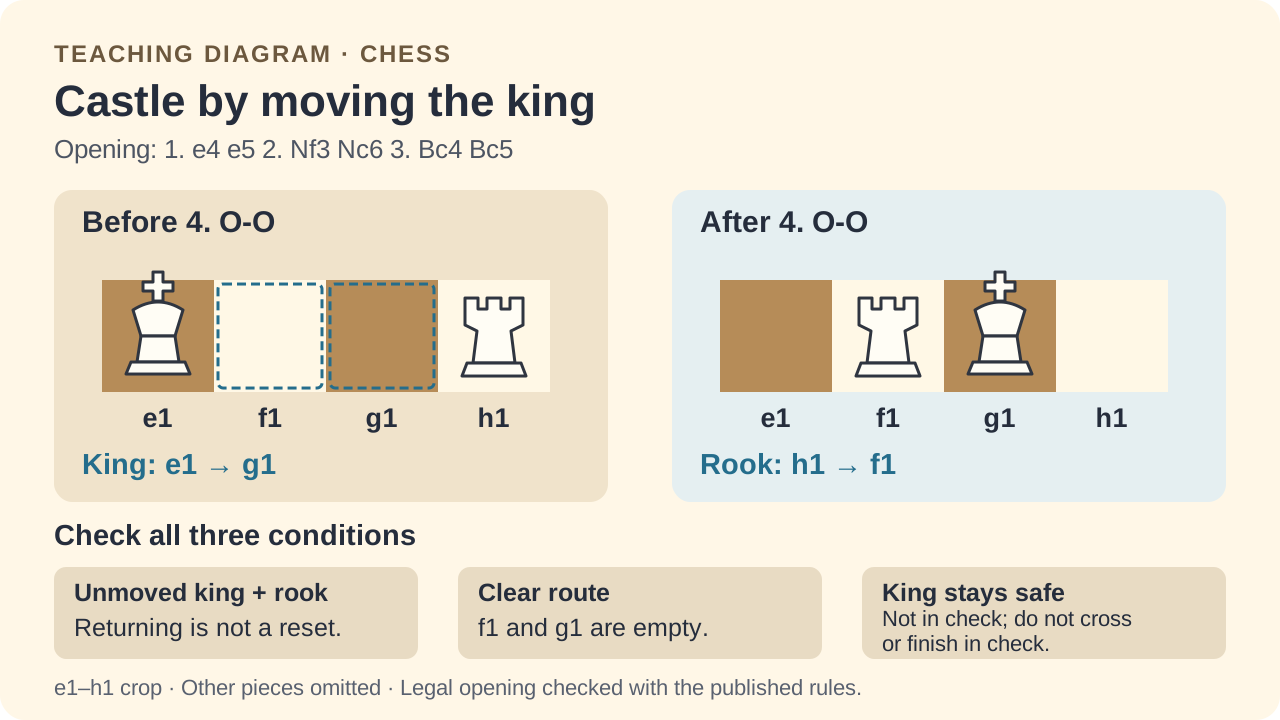
Castle by selecting the king, not the rook
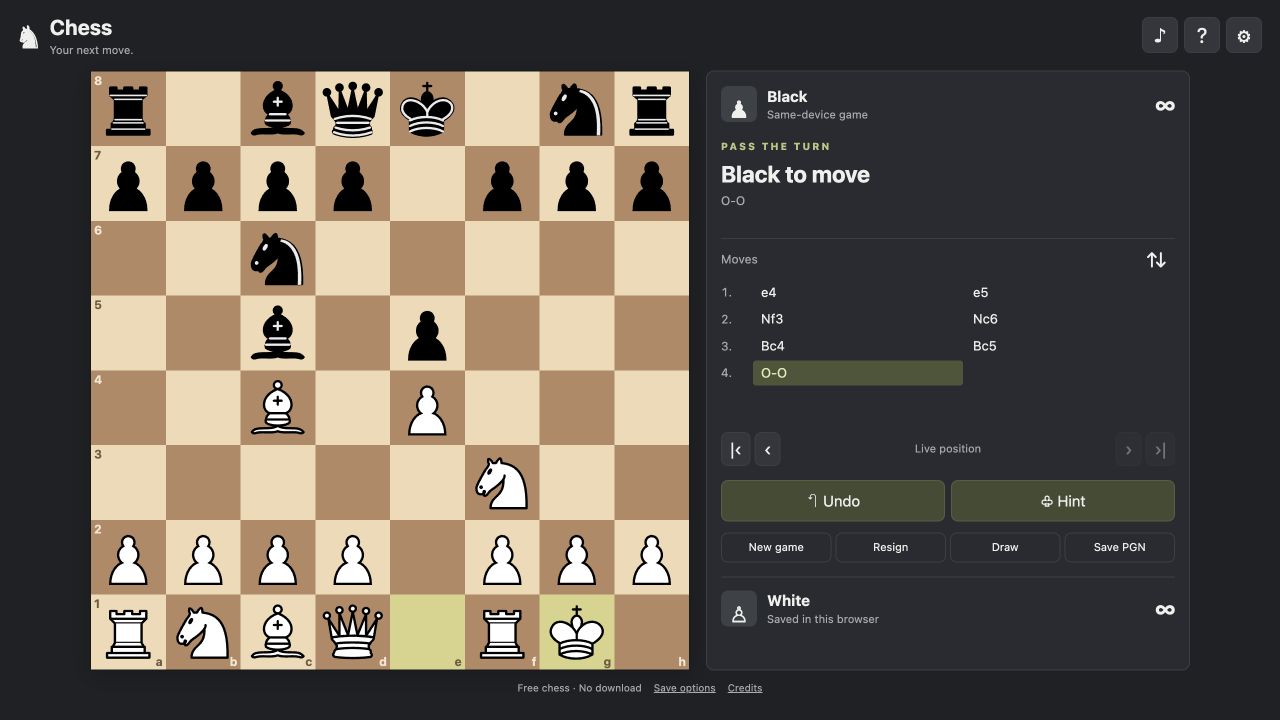
In that position, select the White king on e1 and move it two squares to g1. The h1 rook moves to f1 as part of the same move. The move list records O-O. The screenshot shows the completed position, so you can compare both pieces rather than looking only at the king.
A clear route is only one requirement. Neither the king nor the chosen rook may have moved earlier. The king cannot already be in check, pass through an attacked square, or finish in check. Moving a piece back to its starting square does not restore the right to castle. If g1 is unavailable, check those conditions rather than dragging the rook toward the king.
The lesson of this opening is preparation: moving the knight and bishop created an option. In the same way, a useful mahjong solitaire move is often valuable because of the choices it opens. The rules differ, but asking what becomes possible next helps in both games.
When your king is in check, answer that threat first
Check means the opponent attacks your king. Your next move must remove that attack. Depending on the position, you can move the king to a safe square, capture the attacking piece, or block the line of attack. A knight’s attack cannot be blocked by putting a piece between the knight and king.
Before taking an apparently free piece, check the opponent’s reply. Would your move uncover an attack on your king, leave your queen undefended, or ignore a check that already exists? The game rejects moves that leave your king attacked, but a legal move can still lose another piece. Capturing the king is never the objective; a game ends in checkmate when the checked side has no legal escape.
- What changed on the opponent’s last move?
- Is my king currently attacked?
- Which opponent piece can capture on my intended destination?
- What line or defender will I remove by moving this piece?
No legal moves: checkmate and stalemate are different
Consider two constructed endgames. Put White’s king on c6 and queen on b6, with Black’s king on a8 and Black to move. Black has no legal move, but the king on a8 is not attacked. That is stalemate: a draw, even though White has much more material.
Keep White’s king on c6 and move the queen to b7 in a second teaching position. Now the queen attacks a8, Black still has no legal move, and White’s king protects the queen. That is checkmate. These small positions were checked with the released game’s chess rules; they are teaching examples rather than captured endings from our opening game.
When you are ahead, inspect the opposing king’s available squares before every checking attempt. A queen can remove all escapes without actually giving check. FoolFish also automatically recognizes insufficient material, threefold repetition and the fifty-move rule. A bigger army alone is not a completed win.
Two pawn rules worth learning before they surprise you
A pawn reaching the far rank promotes. In FoolFish Chess the choice menu offers queen, rook, bishop or knight. A queen is often useful, but check the resulting position rather than assuming that one choice is always correct; promotion still has to leave your king safe.
En passant is a time-limited pawn capture. For example, if your White pawn is on e5 and Black advances a pawn from d7 to d5, White may immediately capture from e5 to d6, removing the pawn on d5. The right expires if White makes a different move. It also requires a legal position: the capture cannot expose your king to check. An old two-square pawn move does not leave a permanent sideways capture available.
Use Hint, review and Undo for different questions
Hint suggests a move; it does not explain an entire opening or guarantee a win. Before playing it, identify the threat it answers or the piece it develops. Turn off legal-move highlights later if you want to test whether you can find the same destinations yourself.
Selecting a move in the move list reviews an earlier position without changing the current game. Use Current position to return before continuing. Undo changes the live game: against the computer it normally takes back your move and the reply, while same-device play takes back one move. Reviewing and undoing are separate actions.
Save PGN opens the move record for copying. The short example above reads 1. e4 e5 2. Nf3 Nc6 3. Bc4 Bc5 4. O-O. Keeping that record helps you revisit a specific decision rather than relying on a vague memory that the opening felt good. The UI exports PGN; this guide does not assume it can import a custom position.
Keep your practice game available
Timed games offer optional time per side and increment. Clocks start after the first move and pause while a menu is open, during move review, and while the tab is hidden. This is a casual local practice system, so do not treat its clock behavior as a remote tournament rule. Unlimited time is the clearer starting point when you want to explain each choice.
Guest saves stay in the same browser. Sign in on FoolFish before opening the game to use supported account checkpoints. If another device has a different saved position, open Save options and deliberately choose this board or the cloud board. Copy PGN before replacing a game whose moves you want to keep.
For your next session, choose one task: develop a knight and bishop without leaving them undefended, prepare a legal castle, or review the first move where your opponent created a threat. If you want a board game focused on compulsory capture chains instead, read the Checkers rules and strategy guide.
Common questions
Why can I not castle even though the squares are empty?
The king and rook must both be unmoved, and the king cannot be in check, cross an attacked square or land in check. A piece returning to its starting square does not restore castling rights.
Do I win by taking the king?
No. Checkmate ends the game when the opposing king is attacked and no legal move removes the attack. The king is not captured.
What does a computer level such as 10 mean?
It selects a difficulty setting in the local computer engine. It is not a rated Elo opponent or a promise of a particular playing strength.
Why did having no legal moves produce a draw?
If the side to move is not in check, having no legal move is stalemate. If its king is in check and no move escapes, it is checkmate.
Can I play with a friend on another device?
Play a friend is for two players sharing one device. It does not provide remote matchmaking.
Does looking at an old move take back my game?
No. Move review displays earlier positions. Return to Current position to continue. Undo separately changes the live move history.