
Klondike Solitaire: Draw 1, Draw 3 and the move worth making
Klondike Solitaire asks you to build four suits from ace to king, but most of the interesting decisions happen before a card reaches a foundation. Which hidden card can you uncover? What would an empty column let you move? Is a trip through the stock giving you a useful new option? This guide uses the released FoolFish game and a reproducible deal to explain those choices.
Read the table before drawing a card
The seven tableau columns are your working space. They contain face-down cards with a visible card or run below them. The stock is the face-down pile you draw from; the waste is the pile it feeds. The four foundations collect individual suits. A completed foundation contains an ace, then 2 through 10, jack, queen and king, all of the same suit.
Tableau building runs in the opposite direction: downward, alternating red and black. A red seven can go on a black eight; a red seven cannot go on another red eight or on a black seven. An already ordered face-up run travels together. Moving the last exposed card away from a covered card turns that covered card face up automatically. That reveal is often the most useful result of a move.
- Foundations: same suit, ace upward to king.
- Tableau: one rank lower, opposite colour.
- Waste: only its top card is available.
- Hidden cards: uncover them by moving the visible cards above them.
A real first move: the ace that reveals a five
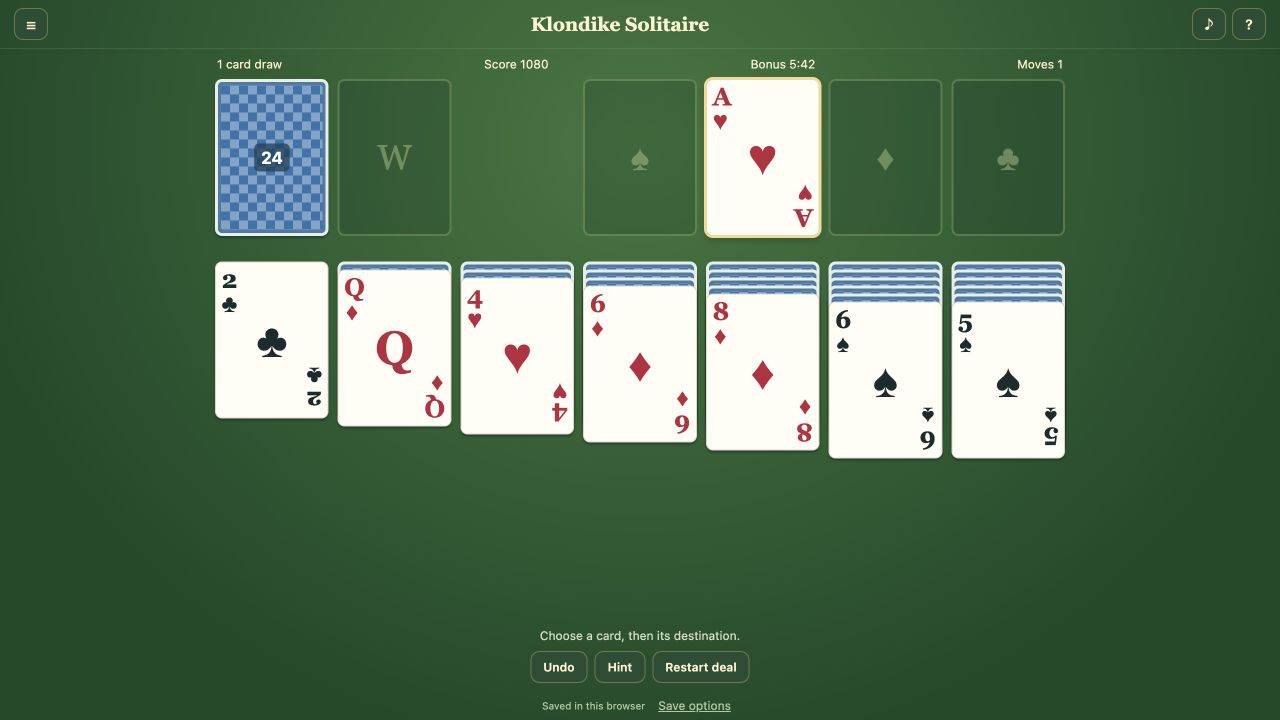
To reproduce our example in FoolFish, choose 1 card draw and enter Deal number 42 before pressing Play. The seven initial visible cards, from left to right, are the two of clubs, queen of diamonds, four of hearts, six of diamonds, eight of diamonds, six of spades and ace of hearts. This is a recorded opening example, not a promise that the entire deal will be solved.
Select the ace of hearts in column seven and move it to the hearts foundation. The five of spades underneath turns face up. You have advanced a foundation and gained information about a column that began with six covered cards. In our fresh Draw 1 run, the displayed score rose from 1,000 to 1,080 and Moves changed from 0 to 1. The screenshot shows that actual result.
Now compare the five of spades with the exposed six of diamonds in column four. Black five on red six is legal. Moving it can expose the next hidden card in column seven. Count that benefit before drawing blindly from the stock. An available move is a question about what it changes, not just somewhere a card can fit.
Draw 1, Draw 3 or Free placement?
Draw 1 exposes one stock card at a time. It is a useful starting mode when you are learning to compare a waste move with a tableau reveal. Draw 3 exposes up to three stock cards, but only the top one is playable. Seeing a helpful card underneath does not make it available: move the cards above it or continue through the stock.
Once the stock is empty, clicking its recycle control turns the waste back into the stock. Changing which waste cards you remove changes what is available on later passes. A card you could not use earlier may become useful after you reveal a new tableau card. Still, cycling without changing the board or waste does not automatically create a new opportunity, and recycling costs points in this release.
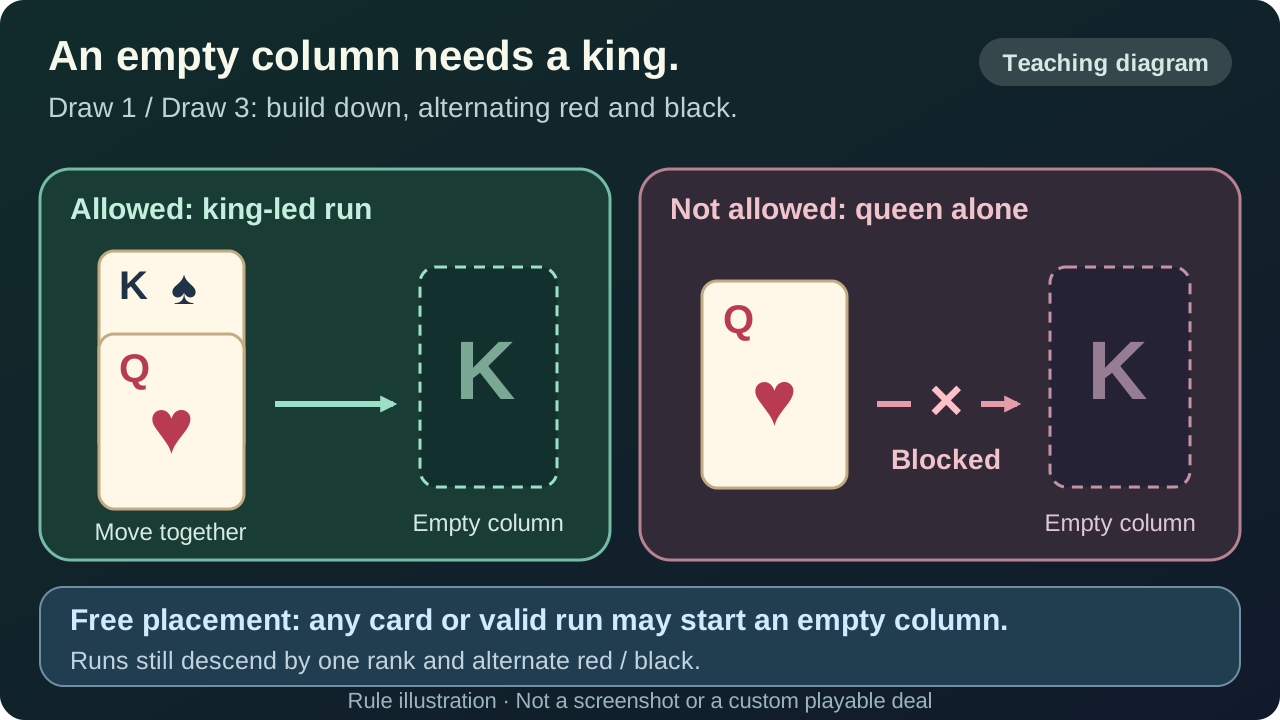
Free placement changes a second rule as well as drawing one card: an empty column can accept any card or valid run. Standard Draw 1 and Draw 3 allow only a king or a king-led run into an empty column. Choose a mode deliberately; do not apply advice about unrestricted empty columns to a standard deal.
An empty column needs a job
In a standard deal, clearing a column is useful when you have a king or king-led run ready to occupy it. Before moving that king, compare the two possible colours and the cards you could build beneath each. If your next needed move is a red queen, a black king gives it a home. Filling the space with a red king would not solve that immediate problem.
This does not mean you should wait forever for a perfect king. Compare what each legal option reveals and whether it opens a route for a longer run. The teaching diagram uses a small imagined position to isolate the rule; it is not a screenshot or a custom board that can be loaded into the game.
Choose a reveal, not just another rearrangement
Before a move, ask three questions: does it expose a covered card, release a blocked waste card, or make room for a useful king-led run? A move can achieve several of those at once. Moving a visible run between two similar columns without opening anything may be legal while leaving your choices almost unchanged.
An ace or two often has a clear foundation move, but later cards deserve a glance at the tableau. A card that fits its foundation might still be supporting a run of the opposite colour. This edition allows a top foundation card to move back to the tableau, at a scoring cost, if you need that support. Keep that option in mind without treating every foundation move as either always correct or always dangerous.
The distinction between a legal move and a useful move also appears in our mahjong solitaire strategy guide: exposing something changes your future choices. The rules are different, but checking what a move opens is a practical habit in both games.
Use Hint and Undo to investigate a decision
Hint marks a candidate move or suggests drawing or recycling the stock. It is a suggestion, not a proof that the deal can be won. Try to explain what the highlighted move opens before taking it. If there are no available moves, inspect the waste, available kings and the last decision that hid a useful route.
Undo retains up to 64 recent actions. It removes the points earned by the action being reversed and then deducts a further 50, with the score staying at zero or above. We checked this in deal 42: undoing the ace move took the score from 1,080 to 950 and restored Moves to 0. It did not leave 1,030. The original 80-point gain was removed as well as the undo penalty.
For learning, spending those points may be worthwhile if you compare the restored position with the move you tried. Restart deal returns the same cards to their original places and restarts the score and bonus clock. A new deal changes the cards. Those controls serve different purposes: replay a decision with Restart, or explore a different layout with a fresh deal.
The bonus clock does not end your deal
The six-minute display is a bonus clock. Reaching zero does not make you lose or stop you moving cards. You can continue solving the deal, although no time remains for that part of the finishing bonus. For a first practice game, understanding a reveal is more useful than rushing because the clock is visible.
Auto complete becomes available only when the stock and waste are empty and every tableau card is face up. Until then, you still need to resolve the hidden information yourself. The objective remains all 52 cards on the four foundations; a clear-looking tableau or a high score alone is not a completed deal.
Continue game restores the board saved in this browser. Signing in on FoolFish before opening the game enables account checkpoints. Use the game's Save options for the actual save state rather than assuming an anonymous board has already followed you to a different device. On desktop you can drag or select a card and its destination; touch uses the same selection idea, and Tab with Enter supports keyboard play.
Take one useful habit into your next game
For your next Klondike session, choose Draw 1 and practise making one reveal before each unnecessary stock pass. Name the card you hope to uncover or the run you want to free. You cannot control the deal, but you can make your reason for a move clearer.
If you prefer building a whole descending sequence before removing it, our one-suit Spider Solitaire guide explains that different objective. Fish Solitaire uses the Klondike rules with ocean artwork; card games includes other formats when you want a different kind of decision. Return to Klondike Solitaire to try the deal or start your own.
Common questions
Why can I see a waste card but not move it?
Only the top waste card can move. In Draw 3, the other visible cards are underneath it; a visible face is not the same as an available card.
Why will an empty column reject my queen?
Standard Draw 1 and Draw 3 accept only a king or king-led run in an empty column. Free placement explicitly allows any card or valid run.
Does the six-minute clock make me lose?
No. It controls a finishing time bonus. The deal remains playable after the bonus clock reaches zero.
Why did Undo remove more than 50 points?
Undo first removes the undone action's earned points, then applies an additional 50-point penalty. Scores cannot go below zero.